Module 3: OLJ Task 6 – Virtual and Augmented Reality

Virtual and augmented reality (VR and AR respectively, or VAR) is another subject I have learnt about previously, so I do have some interest and excitement about it. Hannah et al (2019, p. 1) defines VR as being used to create an environment, “allowing users to explore entirely simulated worlds through headsets, which translate software into immersive worlds”, while AR “superimposes computer-generated images onto views of the real world”.

VR:

AR:
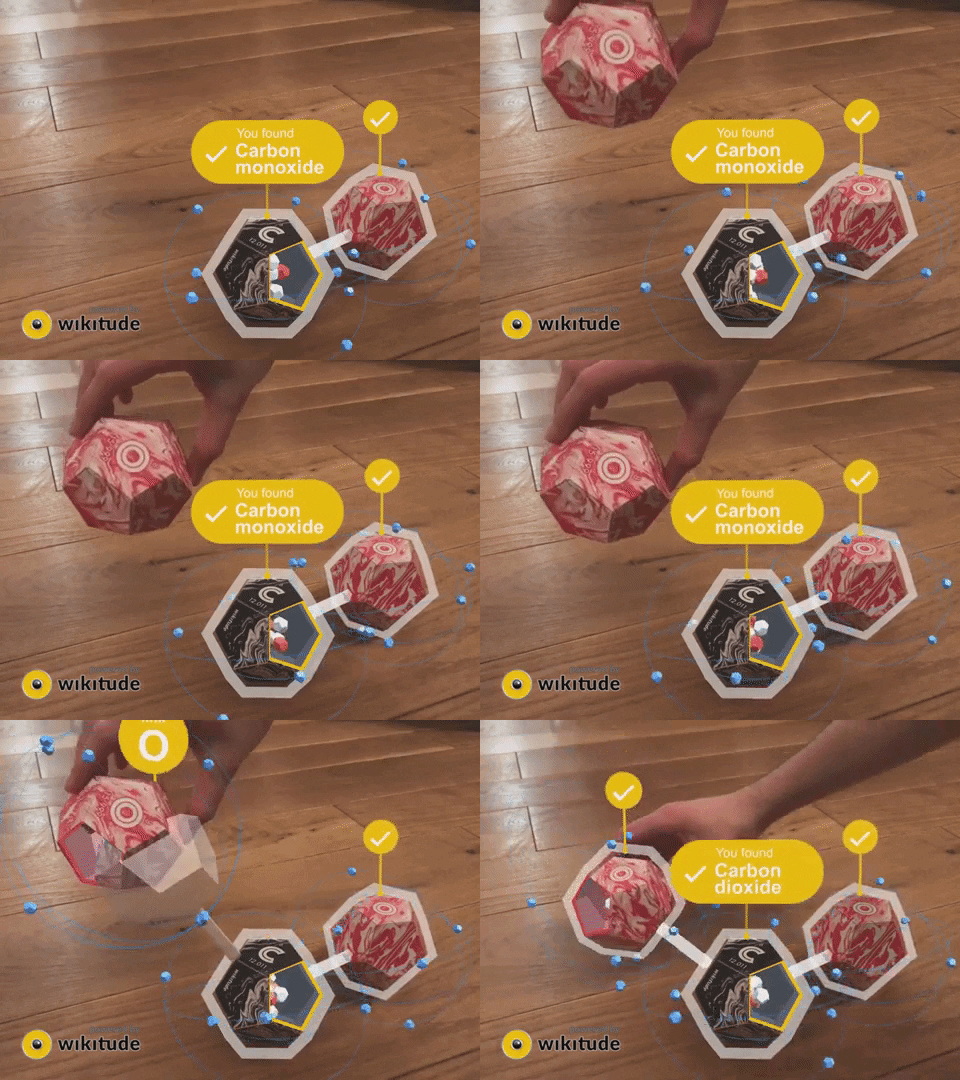
There is a lot of speculation on whether VAR will succeed where other new, exciting technologies have failed. Cost, cumbersome devices and setups, and incompatibility between gaming platforms (PlayStation and Xbox games will not work on the opposite brand’s VR) are some reasons why VR hasn’t been an astronomical hit (Yan & Webb, 2018). However there are some truly great benefits to VR and AR, particularly in the medical industry.

In the article “Virtual reality: A survey of use at an Academic library” (Frost et al, 2020), the benefits of VR in universities are discussed, notably in the medical field. Students can practice virtually before attempting surgery on a real person. They can also learn empathy by being put in the place of their patients (p. 2). New research is showing growing evidence of VR reducing acute pain during hand therapy for burns victims by providing a stimulating distraction (Hoffman et al, 2020, p. 255).

There are both advantages and disadvantages to using VAR in library settings. Most advantages relate to university settings, such as partnering with faculties to develop content for their classes and also to develop tools related to their respective disciplines (Pope, 2018, p. 10). Public library installations of VAR are mostly for the purpose of showcasing new technologies to the public, either to prospective buyers or to the simply curious (Varnum, 2019, pp. 101-102), however there are some workplace applications such as librarians using AR to see which books are out of order on the shelves. Local gaming communities have had enthusiastic responses to VAR in public and university libraries, with clubs forming in response to the VAR equipment (Pope, 2018, p. 9).

Major disadvantages to VAR relate to access, privacy and security. The collection of user data leads to legal and ethical problems and the risk of data breaches (Varnum, 2019, p. 104). If a customer requires books about a sensitive medical issue, their personal privacy is at risk if the application being used by the library is hacked. There is also the possibility of unduly offending customers with a technology like AR that suggests other resources as you walk among the shelves. Parents may not want their children recommended “The Joy of Sex” while they wander the shelves looking for the section on animals. While VAR has great potential for libraries, the development of applications and programs will need to address such concerns before they are implemented on a broad scale.


Frost, M., Goates, M. C., Cheng, S., & Johnston, J. (2020). Virtual Reality. Information Technology and Libraries, 39(1).

Hannah, M., Huber, S., & Matei, S. A. (2019). Collecting virtual and augmented reality in the twenty-first century library. Collection Management, 44(2-4), 277-295. doi:10.1080/01462679.2019.1587673

Hoffman, H. G., Boe, D. A., Rombokas, E., Khadra, C., LeMay, S., Meyer, W. J., Patterson, S., Ballesteros, A., & Pitt, S. W. (2020). Virtual reality hand therapy: A new tool for nonopioid analgesia for acute procedural pain, hand rehabilitation, and VR embodiment therapy for phantom limb pain. Journal of Hand Therapy, 33(2), 254-262.

Pope. H. (2018). Virtual and Augmented Reality: Creating special spaces within the library. American Library Association, 49(9-10), 1-30.

Varnum, K. J. (2019). Beyond reality: Augmented, Virtual, and Mixed Reality in the library. American Library Association.

Yan, M., & Webb, K. (2018). Here’s why virtual reality still hasn’t taken off, despite being around for nearly 2 decades. Business Insider Australia. https://www.businessinsider.com.au/reason-virtual-reality-hasnt-taken-off-future-technology-2018-11?r=US&IR=T


Module 2: OLJ Task 2 – The Influence of Technology on Society

Technology has become a central part of society, in the way it operates, in business models, and in the personal lives of individuals. According to Kemp (2020), in the blog post “Digital 2020: 3.8 billion people use social media”, more than 4.5 billion people now use the internet, with nearly 60% of the world’s population already online. The internet occupies over 40% of the waking life of an average internet user.

Companies have the ability to incorporate more and more technologies into their operations: from the production stage all the way through to advertisement. However, a key issue that must be considered is that of the digital divide. According to the 2020 report by the Australian Digital Inclusion Index, more than 2.5 million Australian remain offline, with geography, affordability, age and socioeconomic status being key factors in low digital literacy.

While the digital skills of those with adequate access are very advanced, companies must cater to the circumstances of all users or risk compounding disadvantage. For example, domains such as Gmail or Hotmail will frequently require a code to be sent to the users mobile phone if someone tries to log on from a new device. This is less than helpful if you live in a mobile phone blackspot, have just bought a new computer, and now can’t log onto your email because your old computer remembered your password for you, and you can’t remember what it was.

(This was a common story in the library I worked at, when customers would come to us for help on the computers).

The assumption that all users have the same skillset, literacy, and access to technology is a flaw in the thinking of many companies today, and this digital divide is something that is becoming more of a concern to libraries (ALIA, 2019). Libraries, as community hubs, can provide access to literacy programmes, and are currently doing so with programmes like Tech Savvy Seniors and computer classes. However, libraries need to think proactively about what their customers need and what sort of programmes would help with this. The future needs should be considered along with current ones. Just as roles are being created for running the library’s social media, roles should also be created for literacy skills. Local councils should look towards providing libraries with the funding required to hire more staff and to run programmes.


Australian Library and Information Association. (2019). Digital inclusion: Digital INCITE supplement – November/December 2019.  https://read.alia.org.au/digital-inclusion-digital-incite-supplement-novemberdecember-2019

Kemp, S. (2020, January 30). Digital 2020: 3.8 billion people use social media. We Are Social. https://wearesocial.com/au/blog/2020/01/digital-2020-3-8-billion-people-use-social-media

The Australian Digital Inclusion Index. (2020). Measuring Australia’s digital divide: The Australian digital inclusion index 2020. https://digitalinclusionindex.org.au/wp-content/uploads/2020/10/TLS_ADII_Report-2020_WebU.pdf

Module 1: OLJ Task 1 – Social Media and Society

In the article “Russian Internet Research Agency disinformation activities on Tumblr: Identity, privacy, and ambivalence” (2020, p. 1), Hoch looks at a case study of a fake account whose aim was to spread disinformation on the platform. Through the case study and qualitative interviews with Tumblr users, Hoch investigates the platform conventions and social norms that were utilised by the fake account to facilitate its distribution of disinformation.

This article was interesting to me as I have researched ‘fake news’ for previous assignments, and as such it is a real concern to me. The sophisticated approach taken by the fake account is worrying, and it is clear that the creators have a lot of practice when it comes to such activities. I have come across many troll accounts on Facebook, and while most are easy to spot once you look at their page, some are definitely difficult to identify, and it must be even more so on an anonymous platform like Tumblr, where you don’t have the same cues to look for.

Compared to Facebook, whose user numbers are in the billions, Tumblr has a much smaller base by far. Yet the group behind the fake account in question, the Internet Research Agency (or IRA, which has ties to the Russian government), adapted its approach to the conventions and social norms of each platform it operated on (pp. 1-3). The purpose of the disinformation (in this case anti-Clinton political posts leading up to the 2016 US election) was create confusion, to exacerbate ideological differences and make citizens question mainstream news outlets, rather than to be persuasive and make a direct argument (p.8).

The account created a fake identity by stealing a user icon and posts from a real Twitter account, and proved adept at giving the impression of being from a different demographic – in this case a young Black woman – by imitating speech structure and choosing gifs featuring Black individuals. The account originally drew in followers by posting humorous, highly visual posts – in keeping with Tumblr’s visual nature – before it started its ulterior campaign, and began making posts under the guise of being a concerned, politically minded individual. Followers who then re-posted the message would become part of the disinformation campaign by re-framing and redistributing messages for the next viewer (p. 5). This ties in with the true purpose of creating the post, not make a direct argument, but to muddy the waters and destabilise the conversation.


Neill Hoch, I. (2020). Russian Internet Research Agency disinformation activities on Tumblr: Identity, privacy, and ambivalence. Social Media + Societyhttps://doi.org/10.1177/2056305120961783

Introduction

A brief introduction…

Hi, my name is Tammy. I’m a qualified Library Technician and I’m in my second year of my degree. I have 12 years’ experience working in libraries. I started out as a junior Saturday shelver at my local library while I was in high school, and after I finished I became a casual and completed a Cert 3 and Diploma from TAFE.

I have a Facebook account, which I mainly use because of the Messenger app and to look at pictures of birds and cats. I was on Twitter briefly, but I didn’t like it so I deactivated my account. Jumping back into it, I immediately remembered why I left *sigh*. I don’t like that feeling of getting immersed in scrolling, and being unable to look away, so one social media account is enough for me.

I’ve done some Professional Development activities on marketing that involved social media, and I found it interesting to know how networks compare in terms of what types of posts work well on a given site, so I’m looking forward to learning more about that. I haven’t used Instagram or Diigo or a blog before, and I’m curious to know more about those as well.

(The featured image is a photo I took on the Twin Falls walk in Springbrook National Park on the Gold Coast. If anyone ever visits the area, I highly recommend doing the walk.)