
Reflection
Before beginning this subject, I already had some experience with social media. I have a Facebook account, which I mainly use to share pictures of cats and birds and to use the Messenger app. I had a brief Twitter account several years ago, but none of my friends were on it with me, and I found the experience to be very shallow (my personal opinion is that everyone on Twitter is yelling into the void, trying to convince others they’re special). I had briefly tried Pinterest and Reddit; I hadn’t tried Instagram; and who with an internet connection hasn’t watched at least one video on YouTube?
I did enjoy parts of Reddit, such as the fact that there’s a sub for any and every topic, so you can always find a conversation on something you love. However, I constantly found myself opening the app and then resurfacing from my endless scrolling an hour later, realising it was time for bed, and feeling guilty that I hadn’t spent my evening doing something more productive, like reading more of my book.
This is the main reason I only use the one social media account. I find it far too easy to get sucked into endless scrolling, and I don’t like the feeling of automatically reaching for my phone, or turning on my phone to do something else but somehow automatically opening Facebook instead. Having multiple apps only makes this worse.
The platforms I engaged with over the course of the session were the class Facebook group, Instagram, Twitter, and Diigo. I had experience with Twitter, as I said before, however my only knowledge of Instagram was its reputation for hosting ‘influencers’, and I had never heard of Diigo.
I enjoyed using the Facebook group to communicate with others, as it felt more relaxed and therefore easier to share random snippets of information I came across. The ‘likes’ people gave to my posts, even if they didn’t comment, also gave a better sense that people were reading the information and taking it on board, and I wasn’t just talking into thin air. While this is mostly self-gratification, it gives a greater sense of connection to classmates than posting on forums like we usually do.
After using Twitter and Instagram for a while, I began to see how the content they posted differed between each other and Facebook. For example: the State Library of New South Wales’ (SLNSW) Twitter and Instagram accounts, specifically the same image shared at different times, a photo from a Black Lives Matter protest near Sydney Town Hall (2021-a, 2021-b). The tweet has a shorter message and is comprised of a quote and several links to related webpages. The Instagram post has a longer message with different wording, and it has several hashtags and @tags to relevant accounts, such as the photographer, the host of the exhibition the image is being displayed in, and several other photographers who will also be featured. Meanwhile, the corresponding Facebook post has slightly different wording again, with lengthier sentences and less tagging (2021-c). Other Instagram posts contain blocks of hashtags at the bottom of the descriptions, while other tweets may be retweets.
By comparing these methods of posting the same image, and by viewing the broader content of both accounts, it is easier to see how Twitter and Instagram could benefit me as an information professional. Twitter is much faster paced, containing rapid dialogue, sharing of information, and re-tweets. Tweets are often about ‘the thing I just learnt’, such as an interesting article. Instagram on the other hand is crafted, posed, and about the promotion of a book or event. Its blocks of hashtags create the sense of reaching out to others in the same community, and the tagging of the author of the featured book gives a feel of authenticity. This is confirmed by Young and Rossmann (2017, pp. 9-12), who state that images can be harnessed to convey information quickly, build empathy and awareness, and appear more authentic. If I were to continue to use these platforms in the future, I would use Twitter as a method of discovering professional development opportunities, such as articles to read or webinars to watch, and I would use Instagram as a way to simply connect with the library and book-loving community.
I had trouble using Diigo. It wasn’t obvious to me how it was meant to be used, and I wasn’t sure how to find other groups and profiles to connect with, if that was what I was meant to be doing at all. I’m curious about its function for saving articles and highlighting sections of interest; I think it would be a useful tool for collating information for my personal use. However, to me it seems more like a professional development aggregator than a social platform.
Kemp (2020) reports that over 4.5 billion people now use the internet, with nearly 60% of the world’s population already online, and 3.8 billion people use social media. Meanwhile, the 2020 report from the Australian Digital Inclusion Index states that more than 2.5 million Australians remain offline, with geography, affordability, age, and socioeconomic status being key contributors to this digital divide.
These numbers put into perspective for me why digital illiteracy, and its cousin media illiteracy, are becoming more important in today’s web-based society. Both literacies are subjects of interest for me. I have seen in my work at public libraries how people struggle when they aren’t even sure of how to use a mouse, and it worries me what will happen to those who don’t develop their skills in the future. And on Facebook I see constant posts full of misinformation, which are stupid at best, offensive and harmful at worst. The conspiracies surrounding the current pandemic, and the way they hamper efforts to control and eliminate the COVID-19 virus, are the best example of the true impact of media illiteracy.
I think information literacy and its subsidiaries will be the biggest challenge for libraries, as services and technologies become more and more dependent on the internet. Second to this is the erosion of privacy online. Collecting and selling your data to advertisers goes so far as to note where you’ve been (Valentino-DeVries et al, 2018). Me and My Shadow (2017) outlines how companies are creating profiles that include an individual’s political beliefs, gender, sexual orientation, economic status, and interests, and that individual has very little control over how/when the data is collected, who it is shared with, and what it is used for.
I have been aware of tracking like this for a few years, and I take precautions to use privacy protection to block ads, trackers, and wipe cookies. I also review my privacy settings on Facebook regularly to make sure as little information as possible can be collected about me. What I have learnt in this subject has reiterated for me how important it is to stay on top of such precautions. It also circles back around to the need for me as an information professional to push my library to hold digital literacy programmes for our customers.
I found the process of researching subjects for the blog posts to be enjoyable. It was stimulating to read about a topic and then research how it might or already is impacting upon the library profession. The simple fact that 2.5 million Australians remain offline leads to the question of what impact is felt by those people, and how libraries can assist them (as I discussed in the OLJ task for Module 2). Meanwhile, Virtual and Augmented Reality (VAR) is already being implemented in libraries, and this leads to an exploration of how it is being used, what future uses may be, and issues associated with such technology (Module 3).
I find that I am a visual learner, and the process of constructing a blog site was entertaining for me, as it laid out in a clear structure what I have learnt so far. I also found it satisfying when I could tag multiple blog posts with the same subject. For instance, I tagged two posts under ‘fake news’ and ‘disinformation’, and just having the visual of the number 2 after both tags gave me a sense of achievement and recognition of the fact that I was building upon my own knowledge. It also highlighted for me what topics I am most interested in.
It was engaging to read posts from other students, to compare my own thoughts on an article with theirs, and with other students who had also written about the same article. Different people take away different points from the same subject, and it expanded my understanding of an article to have these other points and quotes highlighted and examined. For example, Naomi also discussed VAR in one of her posts (2021). Whereas my discussion was concerned with more broad advantages and disadvantages of VAR in the library setting, Naomi focused on VAR in VET libraries due to her work at a TAFE institute. Reading the two posts led to a more holistic understanding of the topic for me rather than just writing my own view.
Overall, I have enjoyed conducting research and posting blogs on a regular basis. I enjoyed learning the theory behind how to create a social media strategy, and I can see how I benefit from such information, whether it is casually assessing my own workplace’s social media to see if I can make suggestions, or if I were to try to create my own blog. Creating blog posts was more time-consuming than I had thought, even though they were only 400-words long. But the snippets of information garnered to write the posts have piqued my interest, and they have given me more to think about in terms of what issues and innovations are affecting libraries.
Going back to why I only use one social platform, despite the benefits I discovered with Twitter and Instagram, using several platforms across the session has confirmed for me that I prefer to stick to one. The competition for my attention from Facebook, Instagram and Twitter was tiring. I remembered why I left Twitter years ago (it still seems like screaming into the void for attention to me), and the fact that Instagram is mobile-based and not completely compatible for PC bothers me. I also find its visual nature to be somewhat shallow, and obvious in its attempt to grab my attention. It is a platform for promotion of some kind, and nothing else.
Facebook suits my needs. It is compatible for mobile and PC, its posts contain more information, and it isn’t restricted to one style of post – it can share an image, or plain text, or a quick link, or a mini-essay, depending on the need. As Young and Rossmann point out, it really is versatile and a one-size-fits-all base (2017, pp. 9-12).
Word count: 1812
Kemp, S. (2020, January 30). Digital 2020: 3.8 billion people use social media. We Are Social. https://wearesocial.com/au/blog/2020/01/digital-2020-3-8-billion-people-use-social-media
Me and My Shadow. (2017). Trackography. https://myshadow.org/trackography
State Library of New South Wales [@statelibrarynsw]. (2021-a, January 21). “What stood out at this one was the sheer reverence that was had by all there.” Photographer @Jamesbrickwood spoke to [Tweet]. Twitter. https://twitter.com/statelibrarynsw/status/1352043504407609344/photo/1
State Library of New South Wales [@statelibrarynsw]. (2021-b, January 12). Out of the 1440 minutes in each day the moments captured by photojournalists become history. From catastrophic weather events to [Post]. Instagram. https://www.instagram.com/p/CJ7PsDIIeYh/
State Library of New South Wales [The State Library of New South Wales]. (2021-c, January 12). Marking its 10th year, the Photos1440 exhibition returns to the Library this Saturday 16 January with a look back over [Image attached] [Post]. Facebook. https://www.facebook.com/statelibrarynsw/photos/a.116332719267/10159245317889268/
Taper, N. [Naomi]. (2021). Virtual & Augmented Reality. Naomi’s INF206 Blog. https://thinkspace.csu.edu.au/naomisinf206/author/naomi-taper2/
The Australian Digital Inclusion Index. (2020). Measuring Australia’s digital divide: The Australian digital inclusion index 2020. https://digitalinclusionindex.org.au/wp-content/uploads/2020/10/TLS_ADII_Report-2020_WebU.pdf
Valentino-DeVries, J., Singer, N., Keller, M. H., & Krolik, A. (2018, December 10). Your apps know where you were last night, and they’re not keeping it secret. New York Times. https://www.nytimes.com/interactive/2018/12/10/business/location-data-privacy-apps.html
Young, S. W. H., & Rossmann, D. (2017). Using social media to build library communities: A LITA guide. Rowman & Littlefield.

Module 6: OLJ Task 18 – Thoughts for the Future
The article I have chosen to discuss is “The little robot that lived at the library: How we built an emotive social robot to guide library customers to books”, by Minja Axelsson (2019). Described in the article is how they identified the need for a robot that could show customers to items and categories within the library, the creation of the robot, and the reactions and feedback provided by customers.
Robotics and Artificial Intelligence (AI) have slowly introduced into libraries over the past several decades. Butters (2006) describes automated systems that streamline the Returns process, from RFID tags, to smart chutes, which instantly take an item off a borrower’s card and turn the RFID tag’s security back on, to bin sorters, which involve conveyor belts dumping items into categorised bins. Boss (2010) identifies benefits of such systems as being: reduced labour costs, books are available to be reshelved quicker, and staff experience less injuries associated with repetitive strain.
The library service I work for has already implemented RFID, self-serve kiosks, and and smart chutes and bin sorters. While this streamlines the returns/lending process, it does not mean staff no longer interact with customers or books. It allows staff more time to assist customers with information requests, and it prevents staff from being overwhelmed by a lot of people returning 20 items at once. I believe that to some extent it also allows the service to pursue community-focused programming, with staff not being diverted as to deal with returns and lending rushes.
The future of robots in libraries I believe lies in further streamlining of processes, and also developing new ideas for library programmes.
-
- Because of the robot described by Axelsson, customers no longer have to queue to speak to a librarian at Oodi Library, and staff are no longer diverted from tasks to show customers where a book is (2019).
- Singapore public libraries employ a shelf-reading robot to find misshelved books overnight and create a report for staff in the morning (Chin Liau, pp. 1-5, 2019), which means that customers have less instances of not being able to find a book, and (in my opinion) staff must have better mental health.
- Longmont Public Library have a robotic staff member designed by and for children on the Autism Spectrum (City of Longmont, Colorado, 2015), which assists these children to practice social skills and engage with the Library.
- Various libraries across Australia are investing in humanoid robots for their STEM programmes, which assist participants in learning how to code and enhancing their digital literacy (Cuong Nguyen, pp. 130-148, 2020)
Axelsson, M. (2019). The little robot that lived at the library [Blog post). Retrieved from https://towardsdatascience.com/the-little-robot-that-lived-at-the-library-90431f34ae2c
Boss, R. W. (2010). Materials Handling Systems for libraries. American Library Association. https://alair.ala.org/bitstream/handle/11213/258/Materials%20Handling%20Systems.pdf?sequence=95&isAllowed=y
Butters, A. (2006). Automated library processes: Achieving success with self-service loans and and returns. Australasian Public Libraries and Information Services, 20(1), 34-44.
City of Longmont, Colorado. (2015). Get to know the BiBlis. https://www.longmontcolorado.gov/departments/departments-e-m/library/just-for-children/bibli-the-library-robot
Cuong Nguyen, L. (2020). The impact of humanoid robots on Australian public libraries. Journal of the Australian Library and Information Association, 69(2), 130-148.

Module 5: OLJ Task 16 – Authentic Information
After reading the 5 items in the module on fake news, there are two messages I think will most inform my work as an information professional.
First is the need to continue to support media outlets and provide access to them to customers. Iosifidis and Nicoli (pp. 60-81, 2019) point out the irony of news media heavily using social media to reach their followers. While using Facebook or Twitter as an aggregator of news sources is convenient, it also opens up readers to exposure to other disreputable articles as they scroll.
However, the paywall that many articles are locked behind is a heavy deterrent to using regular media. If libraries were to continue to subscribe to many, varied outlets, both print and online, it would assist those outlets to continue to make money. It also helps the library to serve the community as a reliable place to discover information.
Second is the (quite urgent) need to focus literacy programmes in the library on media literacy. Johnston (pp. 26-27, 2018) highlights the fact that many people get most or all of their news from social media sources, which comes to them filtered through an echo chamber of like-minded biases, interests and opinions.
Media literacy is defined as the ability “to use critical thinking skills to judge the reliability and credibility of news reports from all media: print, TV, radio or the web”. It refers to the decisions the public must make daily in their personal lives, decisions that have been informed by information sources they find in the media, the internet, and social media (Neely-Sardon & Tignor, 2018, pp. 109-11).
Despite the irritation of having your third cousin constantly sharing conspiracy videos on Facebook, media illiteracy does have a personal impact on people. Opinion, true and false information, and the sheer scope of data means it is difficult to discern fact from fiction. This is especially true for medical information.
Chou et al, (pp. 2417-2418, 2018) discuss the adverse effects misinformation on social media can have on public health, such as the arguments we all would have witnessed about vaccinations over the last year. Such misinformation breeds scepticism about medical guidelines – and again, we all are aware of those arguments regarding Covid precautions.
The global pandemic has cast into glaring light the need for media and digital literacy. Libraries are ideal for assisting with media literacy; they have been found to provide “a neutral, non-stigmatised, non-clinical space” (Crawford et al, 2014, p.168-169) and are used by individuals who may otherwise have difficulty accessing other programmes.
Regarding health information, libraries can reduce the burden on the health system by: empowering people to access and use certified information; providing free usage of internet and information resources; supporting multiple types of information literacy; and ultimately helping with the prevention and early diagnosis of illness (p.168-169).
Chou, W. S., Klein, W. M. P., & Oh, A. (2018). Addressing health-related misinformation on social media. The Journal of the American Medical Association, 320(23), 2417-2418.
Crawford, J. C., Irving, C., Foreman, J., & Higgison, M. (2014). Information literacy and lifelong learning: Policy issues, the workplace, health and public libraries. Chandos Pub.
Iosifidis, P., & Nicoli, N. (2019). The battle to end fake news: A qualitative content analysis of Facebook announcements on how it combats disinformation. International Communication Gazette, 82(1), 60-81. doi:10.1177/1748048519880729
Johnston, N. (2018). Living in the Post-Truth world: Recent research and resources. InCite, 39(3/4), 26–27.
Neely-Sardon, A., & Tignor, M. (2018). Focus on the facts: A news and information literacy instructional program. The Reference Librarian, 59(3), 108-121.

Module 4: OLJ Task 11 – PLN Adoption
In his article “Stages of PLN adoption”, Utecht (2008) identifies 5 stages that people typically go through when trying to develop and maintain engaged with their Personal Learning Network (PLN). These are:
- Immersion into networks
- Evaluation of and focus on networks
- Trying to learn e-v-e-r-y-t-h-i-n-g
- Putting your life and priorities into perspective
- Trying to find a balance between life and learning
My PLN oscillates between points 1 and 4: I get the urge to expand my learning, and subscribe to a new blog, then realise that I have no time (or so it seems) to commit to reading any of it. Thus, I have a limited PLN. I subscribe to the State Library NSW PLN list, which consists mostly of questions and answers between librarians, but also has occasional alerts for PD opportunities and job advertisements.
Hofmann (2017) has a useful blog post on how to manage your PLN. The main point highlighted is that you must find what delivery method works for you, whether it is watching blogs or joining Twitter, using curation sites or email alerts. Personally, I would probably need to look into something like a curation site, as I already receive a lot of emails from the SLNSW list, and I don’t enjoy using Twitter.
I do feel the need to expand my PLN. However, most of the blogs and journals I come across online are American, which doesn’t serve me as well as Australian content would. I have looked into signing up for ALIA’s INCITE magazine (n.d.), but as I can’t afford the subscription cost, only the digital issues are available for me to read.
Part of the reason that I haven’t committed to curating a PLN is the lack of incentive. I have only just started working as a casual library assistant, and my role doesn’t require me to work on projects or plan for the library’s future, so while blogs and learning opportunities may be interesting to me, for now it would serve only to feed my curiosity rather than impact my work life.
Despite this, I do have some idea of what I would like to read about in the future, when circumstances ‘align’ for me. I enjoy learning about what other libraries are doing, what programmes they are running, and I have a lot of interest in Information Literacy. I also find the transition of libraries from ‘house of books’ to ‘community hub’ to be full of possibility, and I love to hear about how libraries are engaging with their local community.
Australian Library and Information Association. (n.d.). INCITE. https://www.alia.org.au/publications-and-news/incite#Subscribe%20to%20incite
Hofmann, J. (2017, January 13).
Utecht, J. (2008). Stages of PLN adoption. The Thinking Stick. http://www.thethinkingstick.com/stages-of-pln-adoption/

Module 3: OLJ Task 6 – Virtual and Augmented Reality
Virtual and augmented reality (VR and AR respectively, or VAR) is another subject I have learnt about previously, so I do have some interest and excitement about it. Hannah et al (2019, p. 1) defines VR as being used to create an environment, “allowing users to explore entirely simulated worlds through headsets, which translate software into immersive worlds”, while AR “superimposes computer-generated images onto views of the real world”.
VR:

AR:
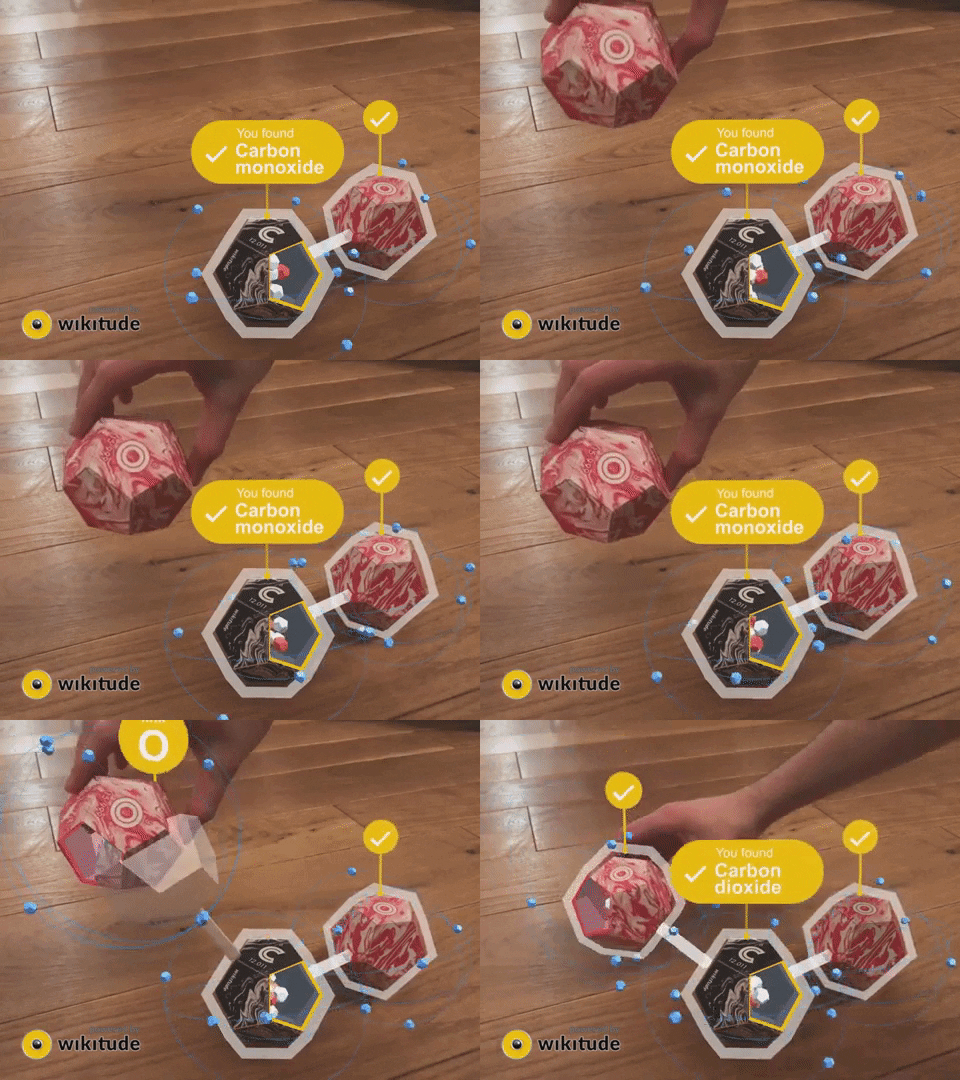
There is a lot of speculation on whether VAR will succeed where other new, exciting technologies have failed. Cost, cumbersome devices and setups, and incompatibility between gaming platforms (PlayStation and Xbox games will not work on the opposite brand’s VR) are some reasons why VR hasn’t been an astronomical hit (Yan & Webb, 2018). However there are some truly great benefits to VR and AR, particularly in the medical industry.
In the article “Virtual reality: A survey of use at an Academic library” (Frost et al, 2020), the benefits of VR in universities are discussed, notably in the medical field. Students can practice virtually before attempting surgery on a real person. They can also learn empathy by being put in the place of their patients (p. 2). New research is showing growing evidence of VR reducing acute pain during hand therapy for burns victims by providing a stimulating distraction (Hoffman et al, 2020, p. 255).
There are both advantages and disadvantages to using VAR in library settings. Most advantages relate to university settings, such as partnering with faculties to develop content for their classes and also to develop tools related to their respective disciplines (Pope, 2018, p. 10). Public library installations of VAR are mostly for the purpose of showcasing new technologies to the public, either to prospective buyers or to the simply curious (Varnum, 2019, pp. 101-102), however there are some workplace applications such as librarians using AR to see which books are out of order on the shelves. Local gaming communities have had enthusiastic responses to VAR in public and university libraries, with clubs forming in response to the VAR equipment (Pope, 2018, p. 9).
Major disadvantages to VAR relate to access, privacy and security. The collection of user data leads to legal and ethical problems and the risk of data breaches (Varnum, 2019, p. 104). If a customer requires books about a sensitive medical issue, their personal privacy is at risk if the application being used by the library is hacked. There is also the possibility of unduly offending customers with a technology like AR that suggests other resources as you walk among the shelves. Parents may not want their children recommended “The Joy of Sex” while they wander the shelves looking for the section on animals. While VAR has great potential for libraries, the development of applications and programs will need to address such concerns before they are implemented on a broad scale.
Frost, M., Goates, M. C., Cheng, S., & Johnston, J. (2020). Virtual Reality. Information Technology and Libraries, 39(1).
Hannah, M., Huber, S., & Matei, S. A. (2019). Collecting virtual and augmented reality in the twenty-first century library. Collection Management, 44(2-4), 277-295. doi:10.1080/01462679.2019.1587673
Hoffman, H. G., Boe, D. A., Rombokas, E., Khadra, C., LeMay, S., Meyer, W. J., Patterson, S., Ballesteros, A., & Pitt, S. W. (2020). Virtual reality hand therapy: A new tool for nonopioid analgesia for acute procedural pain, hand rehabilitation, and VR embodiment therapy for phantom limb pain. Journal of Hand Therapy, 33(2), 254-262.
Pope. H. (2018). Virtual and Augmented Reality: Creating special spaces within the library. American Library Association, 49(9-10), 1-30.
Varnum, K. J. (2019). Beyond reality: Augmented, Virtual, and Mixed Reality in the library. American Library Association.
Yan, M., & Webb, K. (2018). Here’s why virtual reality still hasn’t taken off, despite being around for nearly 2 decades. Business Insider Australia. https://www.businessinsider.com.au/reason-virtual-reality-hasnt-taken-off-future-technology-2018-11?r=US&IR=T

Module 2: OLJ Task 2 – The Influence of Technology on Society
Technology has become a central part of society, in the way it operates, in business models, and in the personal lives of individuals. According to Kemp (2020), in the blog post “Digital 2020: 3.8 billion people use social media”, more than 4.5 billion people now use the internet, with nearly 60% of the world’s population already online. The internet occupies over 40% of the waking life of an average internet user.
Companies have the ability to incorporate more and more technologies into their operations: from the production stage all the way through to advertisement. However, a key issue that must be considered is that of the digital divide. According to the 2020 report by the Australian Digital Inclusion Index, more than 2.5 million Australian remain offline, with geography, affordability, age and socioeconomic status being key factors in low digital literacy.
While the digital skills of those with adequate access are very advanced, companies must cater to the circumstances of all users or risk compounding disadvantage. For example, domains such as Gmail or Hotmail will frequently require a code to be sent to the users mobile phone if someone tries to log on from a new device. This is less than helpful if you live in a mobile phone blackspot, have just bought a new computer, and now can’t log onto your email because your old computer remembered your password for you, and you can’t remember what it was.
(This was a common story in the library I worked at, when customers would come to us for help on the computers).
The assumption that all users have the same skillset, literacy, and access to technology is a flaw in the thinking of many companies today, and this digital divide is something that is becoming more of a concern to libraries (ALIA, 2019). Libraries, as community hubs, can provide access to literacy programmes, and are currently doing so with programmes like Tech Savvy Seniors and computer classes. However, libraries need to think proactively about what their customers need and what sort of programmes would help with this. The future needs should be considered along with current ones. Just as roles are being created for running the library’s social media, roles should also be created for literacy skills. Local councils should look towards providing libraries with the funding required to hire more staff and to run programmes.
Australian Library and Information Association. (2019). Digital inclusion: Digital INCITE supplement – November/December 2019. https://read.alia.org.au/digital-inclusion-digital-incite-supplement-novemberdecember-2019
Kemp, S. (2020, January 30). Digital 2020: 3.8 billion people use social media. We Are Social. https://wearesocial.com/au/blog/2020/01/digital-2020-3-8-billion-people-use-social-media
The Australian Digital Inclusion Index. (2020). Measuring Australia’s digital divide: The Australian digital inclusion index 2020. https://digitalinclusionindex.org.au/wp-content/uploads/2020/10/TLS_ADII_Report-2020_WebU.pdf

Module 1: OLJ Task 1 – Social Media and Society
In the article “Russian Internet Research Agency disinformation activities on Tumblr: Identity, privacy, and ambivalence” (2020, p. 1), Hoch looks at a case study of a fake account whose aim was to spread disinformation on the platform. Through the case study and qualitative interviews with Tumblr users, Hoch investigates the platform conventions and social norms that were utilised by the fake account to facilitate its distribution of disinformation.
This article was interesting to me as I have researched ‘fake news’ for previous assignments, and as such it is a real concern to me. The sophisticated approach taken by the fake account is worrying, and it is clear that the creators have a lot of practice when it comes to such activities. I have come across many troll accounts on Facebook, and while most are easy to spot once you look at their page, some are definitely difficult to identify, and it must be even more so on an anonymous platform like Tumblr, where you don’t have the same cues to look for.
Compared to Facebook, whose user numbers are in the billions, Tumblr has a much smaller base by far. Yet the group behind the fake account in question, the Internet Research Agency (or IRA, which has ties to the Russian government), adapted its approach to the conventions and social norms of each platform it operated on (pp. 1-3). The purpose of the disinformation (in this case anti-Clinton political posts leading up to the 2016 US election) was create confusion, to exacerbate ideological differences and make citizens question mainstream news outlets, rather than to be persuasive and make a direct argument (p.8).
The account created a fake identity by stealing a user icon and posts from a real Twitter account, and proved adept at giving the impression of being from a different demographic – in this case a young Black woman – by imitating speech structure and choosing gifs featuring Black individuals. The account originally drew in followers by posting humorous, highly visual posts – in keeping with Tumblr’s visual nature – before it started its ulterior campaign, and began making posts under the guise of being a concerned, politically minded individual. Followers who then re-posted the message would become part of the disinformation campaign by re-framing and redistributing messages for the next viewer (p. 5). This ties in with the true purpose of creating the post, not make a direct argument, but to muddy the waters and destabilise the conversation.
Neill Hoch, I. (2020). Russian Internet Research Agency disinformation activities on Tumblr: Identity, privacy, and ambivalence. Social Media + Society. https://doi.org/10.1177/2056305120961783

Introduction
A brief introduction…
Hi, my name is Tammy. I’m a qualified Library Technician and I’m in my second year of my degree. I have 12 years’ experience working in libraries. I started out as a junior Saturday shelver at my local library while I was in high school, and after I finished I became a casual and completed a Cert 3 and Diploma from TAFE.
I have a Facebook account, which I mainly use because of the Messenger app and to look at pictures of birds and cats. I was on Twitter briefly, but I didn’t like it so I deactivated my account. Jumping back into it, I immediately remembered why I left *sigh*. I don’t like that feeling of getting immersed in scrolling, and being unable to look away, so one social media account is enough for me.
I’ve done some Professional Development activities on marketing that involved social media, and I found it interesting to know how networks compare in terms of what types of posts work well on a given site, so I’m looking forward to learning more about that. I haven’t used Instagram or Diigo or a blog before, and I’m curious to know more about those as well.
(The featured image is a photo I took on the Twin Falls walk in Springbrook National Park on the Gold Coast. If anyone ever visits the area, I highly recommend doing the walk.)