
The interactive book that I chose to explore is Icky Mr Fox (2014) by Aleksei and Alexander Bitskoff, which is available as a free download on the Google Play or iTunes store. This interactive story is presented through a downloadable app that is aimed at young readers and students in kindergarten. The app is easy to access and has its own series that young readers can choose to continue downloading after they finish each story. This story takes the reader roughly twenty minutes to complete, including all the interactive movements that are presented at different intervals throughout the story.
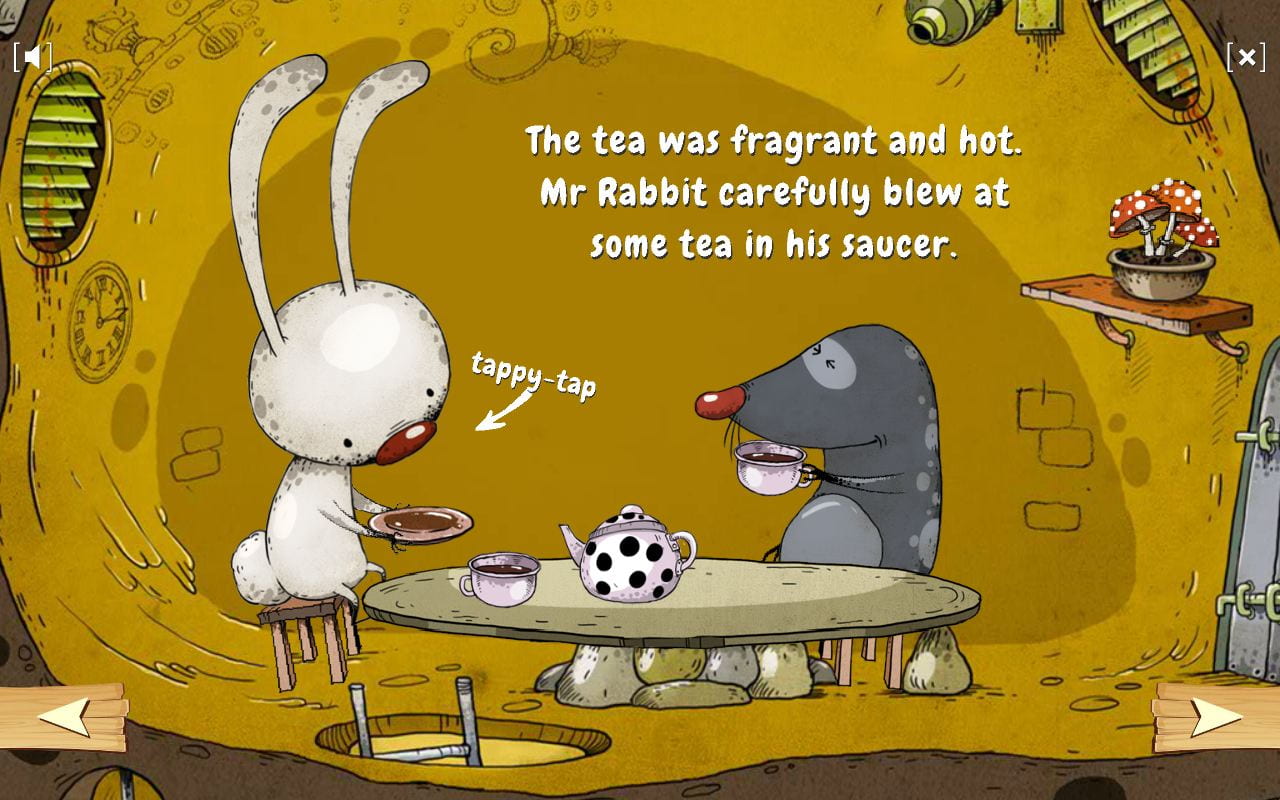 The three characters in this interactive story are Mr Rabbit, Mr Mole and Icky Mr Fox. Each character has interactive actions that are presented at certain intervals throughout the story. These actions are prompted with the use of moving animated arrows that assist the reader with progressing to the next part of the story. The characters are inter-connected, making sure that each action affects one or more of the characters. This imaginative story presents opportunities for young readers to interact with the storyline as each character displays human qualities that add to initial and future readings.
An audio read-to feature is used throughout the story so that young readers can listen to each page. This encourages young readers to concentrate on the printed text that is on the screen and follow along with their finger. Having both the printed font and the audio allows young readers, particularly in kindergarten to gain one-to-one correspondence by tracking where each word is placed in each sentence (Department of Education, 2018). Developing this tracking for reading is vital for these younger readers as it sets them up for future improvements in recalling and comprehending a variety of literature as they strengthen their reading ability.
When the story progresses, the background image changes according to the environment where the character is located. This also means that a lot of household items that are placed in the background are interactive for the reader. Each item can be tapped on, and a label appears with the audio being verbalised as well, telling the reader what that item is. There are between eight to ten items that can be pressed in each background. This interaction acts as a source of creative play that young readers often prefer when listening to an unfamiliar story (Ciffone, Weaver & Read, 2016). The reader listens to these new words that are being read to them, slowly building their own vocabulary by listening and viewing the spelling of the interactive words too.
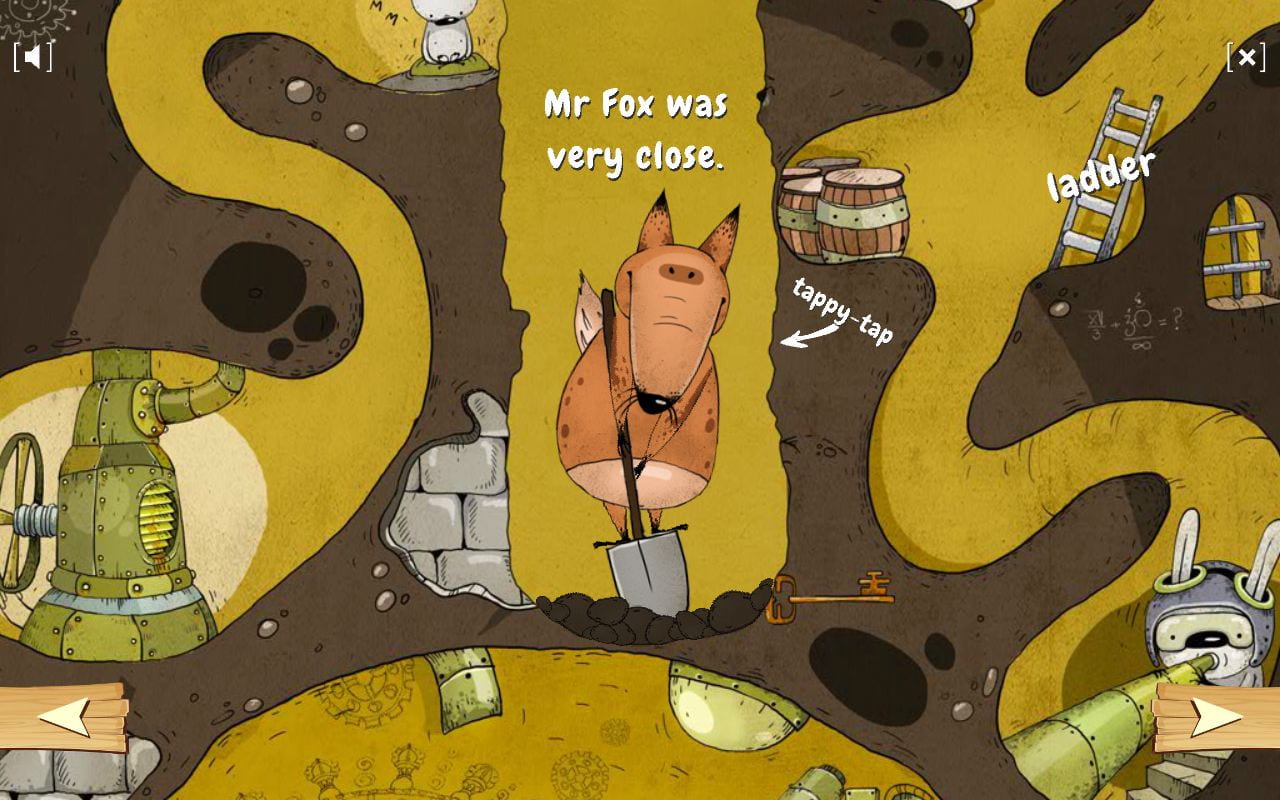
Young readers would be able to enjoy this story as it is structured with animations that prompt them to click to the next part of the story using the arrow at the bottom of the screen. The characters also incorporate certain interactive actions into the storyline, which is prompted after the voice tells the reader about what the character is doing. For example, ‘Mr Fox was very close’ allows the reader to tap on the character and interact with the digging animation linked to this part of the storyline. These moments are shown by the phrases ‘tappy-tap’ and ‘swipey-swipe’ appearing on the screen. This encourages the readers to work on their phonological awareness, concept of print and vocabulary as the story echoes to them (Whittingham, Huffman, Rickman & Wiedmaier, 2013, p. 199).
Comprehension and understanding is an important feature of this interactive digital book. Young readers may struggle to fully comprehend what they need to do without adult supervision. This means that these types of digital texts can assist younger age groups with building their reading habit. Kelley and Kinney (2017) highlight that continual exposure to these types of digital texts will not solely improve the reader’s comprehension ability. The main difference in this situation, however, is that the readers are not questioned throughout this story and are just presented with the storyline as a source of digital media.
There are links to the interaction with digital stories in the English curriculum. This is a skill requisite that children in pre-school and kindergarten need to maintain as it is a different way of interacting with literature compared to physically turning a page (Department of Education, 2018). The other curriculum link that can be investigated by Classroom Teachers (CT) is brainstorming how each character would think and feel throughout the narrative. Demonstrating how a story is structured is also something that could be taught in library lessons for students to interact and experiment while gaining how to comprehend new information from a familiar digital text.
References
Bitskoff, A., & Bitskoff, A. (2014). Icky Mr Fox. [IckyPen app]. Google Play Store.
Ciffone, K., Weaver, & Read, K., A. (2016). The third voice: Do enhanced e-books enhance the benefits of shared story reading with preschoolers? Childhoods Today, 10(1). Retrieved from http://www.childhoodstoday.org/article.php?id=85
Department of Education (DoE). (2018). Reading and viewing. New South Wales (NSW) Syllabus. Retrieved from https://www.educationstandards.nsw.edu.au/wps/portal/nesa/k-10/learning-areas/english-year-10/english-k-10/content/859
Kelley, E. S., & Kinney, K. (2017). Word learning and story comprehension from digital storybooks: Does interaction make a difference? Journal of Educational Computing Research, 55(3), 410-428. DOI: 10.1177/0735633116669811
Whittingham, J., Huffman, S., Rickman, W., & Wiedmaier, C. (2013). Enhanced picture books: Enhancing the literacy development of young children. Technological Tools for the Literacy Classroom, 196-218. Retrieved from https://www-igi-global-com.ezproxy.csu.edu.au/gateway/chapter/full-text-pdf/76211
No Comments