Censorship – how bad is it really?

The last few years has seen global discussions (and even outrage) over the controversial topic of censorship – particularly around books that students may have access to in school libraries. There seems to be two types of censorship that prompt fast and furious discussion. Censorship where publishers might change or omit certain words in books – we all remember the Roald Dahl global event – changing the description of character Augustus Gloop from fat to enormous. Many of us might laugh at the absurdity of these word changes and want our beloved stories to stay as they were originally written. Classic works that potentially paint people in a stereotypical or racial light are also subject to publisher censorship – changes to Australian classics, such as Seven Little Australians by Ethel Turner, or My Brilliant Career by Miles Franklin (Kelly, 2023) are also at the forefront of public discourse.

The second type of censorship is particularly notable in the school library context – that is the removal or access rights to certain texts being controlled by either the public or librarians themselves. This seems to be particularly rife in countries like America and Canada, where parents accounted for 60% of the challenges to materials (Jenkinson, 2002). Although this seems to be a daunting statistic, it is possible that this is merely a fly in the ointment than compared to perhaps the more dangerous form of censorship – school librarians themselves. This type of censorship can even be described as unconscious – when librarians own beliefs and values are projected onto the collection via the selection process (Moody, 2005). In a progressive society like Australia, is censorship really a big problem?

It seems that it might be – possibly without the hype and news coverage we might see from our American counterparts. Censorship occurs in Australian school libraries, and has for decades. Instances such as Harry Potter being removed from libraries in Queensland, and such strict internet filtering that the name Virginia could not be accessed because of the first 6 letters of the name and its connotations (Credaro, 2001) Just because we don’t see images of protest against books, or hear of beloved classics being removed from shelves, doesn’t mean it doesn’t happen in Australia, and will keep happening. The 7.30 report on ABC Australia recently interviewed the former head of the American Library Association, who painted a dire picture of censorship occuring all over the world, and reminded us of protecting individuals ‘right to read’. The video can be viewed here: 7.30 Report Video

As teacher librarians, it is a critical and important issue. If part of our role is information access, then being educated on issues of censorship is important – to ensure we offer our students valuable access to the information that have the right to.

Credaro, A. (2001). Double jeopardy: censorship in school libraries. Orana, 37(1), 4–8. https://search.informit.org/doi/10.3316/ielapa.200109829

Jenkinson, D. (2002). Selection and censorship: It’s simple arithmeticSchool libraries in Canada, 2(4), 22.

Moody, K. (2005) Covert censorship in libraries: a discussion paper in The Australian Library Journal, 54(2), 138-147.

Tingle, L. (Director). (2023, December 5) Librarians warn the push for book censorship is widening in the United States.  7.30 Report, ABC. https://www.abc.net.au/news/2023-12-05/librarians-warn-the-us-push-for-book-censorship-is-widening/103192880


Selection Criteria

Choosing which resources to add to a collection can at times feel like a weighty task. This has been exacerbated by the huge range of resources available in the variety of formats. This can only add to decision fatigue as teacher librarians are not only considering the content of a source, but what format would best service its users. While there may not always be an easy solution, applying selection criteria can narrow down this task to a more manageable job.

Hughes-Hassell and Mancall (2005, p. 43) state that, on top of selection criteria recommended by school library guidance, the most important consideration is whether the resources not only address the teaching and learning context, but also the characteristics of the learners using that library.
This shifts the focus from choosing the best available resource on the topic, sometimes sacrificing literary authority or physical quality, to concentrate on the most appropriate. This guidance makes a lot of sense when we are aiming for engagement and meeting student needs. For example, the content of a novel for an English classroom in outback Australia might be vastly different to a choice made on appropriateness for a school with a large amount of international students. This would fall under the category of treatment – does it appeal to the learners who will use it? I agree with this statement mostly – engaged students do learn.
However, I also think we need to expose students to work that falls under literary merit, for example – even if the content doesn’t seem like it will be appealing to our students. At times, students can surprise us – we need to provide space for students to wrestle with tricky texts and potentially not enjoy and connect with something they are studying. While I realise that Hughes-Hassell & Mancall (2005) are not saying we never consider literary merit, I think at times this consideration can move from secondary to the main group of areas we are evaluating texts with.
Another way of looking at selection criteria comes from The Australian Association for the Teaching of English (n.d.) . They state that texts should be selected for their strengths. This can also help us to narrow down what the text should be primarily used for. Perhaps a graphic novel does not have the best example of dialogue or plot, but it does have beautiful illustrations and would be a great example to use when teaching visual literacy.
More than ever, this module has demonstrated how nuanced collection development can be and why it needs to be undertaken by a professional teacher librarian, who can wrestle with these decisions, in partnership with teaching staff.
Hughes-Hassell, Sandra, and Jaqueline C. Mancall. Collection Management for Youth : Responding to the Needs of Learners, ALA Editions, 2005. ProQuest Ebook Central, https://ebookcentral.proquest.com/lib/csuau/detail.action?docID=289075.
The Australian Assocation for the Teaching of English (n.d.) Censorship and Text Selection. https://www.aate.org.au/documents/item/645

Evolving technology and the collection

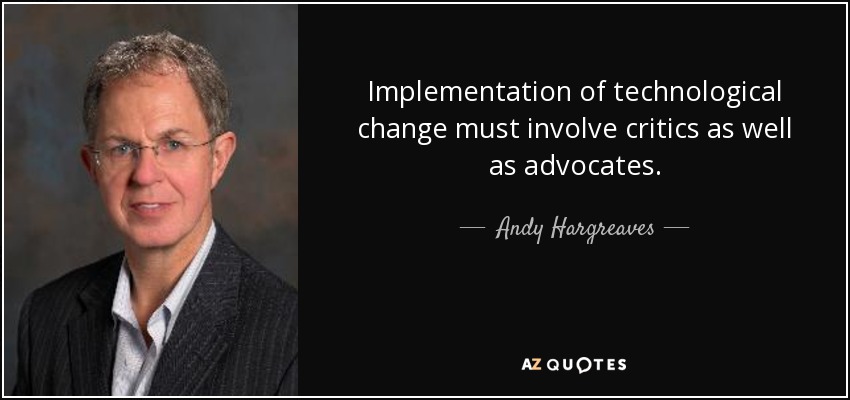
Image source: https://www.azquotes.com/quotes/topics/technological-change.html

The above quote certainly rings very true when thinking about the impact of technologies in not only school libraries, but libraries worldwide. As much as technology seems to be overtaking our very way of life and how we go about our daily tasks, teacher librarians need to play the role of advocate and critic dually when it comes to decisions surrounding the collection. Just as not every book is suitable for the collection, not all technology will resource teachers and students in meeting the curriculum outcomes, or provide positive opportunities to engage in literature in meaningful ways.

The impact changing formats has and will continue to have on collection development is complex and far reaching. Where once librarians were limited for choice in what they could offer their borrowers, they are now spoilt for choice. Endless choice can sometimes cause decision fatigue and can make it increasingly difficult to choose the right resource to meet the selection criteria of the library. Johnson, Hille & Reed (2005) state that selection is both an art and a science, resulting from a combination of knowledge, experience and intuition. Consideration of the impact of this issue is critical when it comes to the knowledge required for building and curating a collection.

Formats can be representative of typical topologies, but also include audio, electronic, online subscriptions, physical games and hobby tools, research guides such as maps and artefacts – if you can use it to gain information, good chance the library will have it!

Changing formats means that teacher librarians need to consider:

  • Budget constraints – is it more cost effective to own a resource or pay a subscription fee? What should be done if the resource is no longer used but a contract remains for a time?
  • Is the bulk of the library collection representative of a bibliocentric stance? Or does a nonbibliocentric approach work best? What portion of funds is divided to resource this?
  • How are these resources catalogued? Are they under format or genre?
  • How can ease of access be ensured for users?
  • Are digital files restricted to one user at a time (is this budget friendly?)
  • How new technologies (which are emerging at a rapid pace) can be embraced in a sustainable manner?
  • Do guides need to be made for users that are not familiar with pathways for accessing newer technology resources?
  • How do we ensure that resources from a variety of formats accurately reflect diversity and help to broaden the views and perspectives of users?
  • How is the responsibility for the management of these resources allocated to staff?

These issues and challenges will only grow as technology emerges and evolves and is integrated further into school curriculums. Perhaps a quote from Peter Dicken (n.d.) will encourage us: ‘Innovation – the heart of technological change – is fundamentally a learning process’.


Johnson, Peggy, et al. Fundamentals of Collection Development and Management, ALA Editions, 2005. ProQuest Ebook Central, https://ebookcentral.proquest.com/lib/csuau/detail.action?docID=474201.


Professional Development

As I reflect on my teaching career thus far, I recall many challenges, frustrations and thoughts of Why did I get into this career! Surely there is something better out there!. Alongside moments fraught with difficulty, there have been many stand out experiences and days when I drive out of the school carpark thinking I feel so lucky to be able to do this. This is so fulfilling. 

I think this is partly because I am a learner at heart. I love to try new things, find out how to conquer an unknown, and if I don’t know how to do something that needs to be done, surely I can figure it out. I see endless possibilities and opportunities in life if you are just open to learning. After promising my family that yes, I was done with university study, I enrolled into the Masters of Teacher Librarianship course. Outwardly they are very supportive, although I am sure there are a few inward groans every now and then. During this particular module of study I have been challenged about my current practice and what I could do to improve this to achieve Highly Accomplished or Lead teacher stage.

Some might say that the title doesn’t matter, it is what you do in the classroom each day for the students. I believe this too. For many years I have said that applying for higher levels of teacher accreditation was a waste of my time and money and that it wouldn’t change the outcomes for my students. In some ways, part of this still rings true, but I also have a new perspective. During Module 2.1, I investigated many of the resources on the Australian Institute for Teaching and School Leadership (AITSL,2017) site. A particular resource caught my eye, detailing how a teacher at an Accomplished stage of teaching, not only works in best practice in their own classroom, but leads and resources other teachers. This struck me as I realised that I could make more of a difference if I challenged myself to improve my skills and abilities in order to further equip other teachers, in turn impacting more students.

As a teacher sitting at a Proficient level currently, I believe that I select and/or create and use a range of resources, including ICT, to engage students in their learning (Standard 3.4, AITSL, 2017) I regularly apply a wide range of resources in my classroom, such as audio and video examples, collaborative learning materials that give students opportunities to demonstrate knowledge through different skills and curate resources that represent a variety of perspectives. If I was to expand my skills in this particular standard to the Highly Accomplished stage, it would require me to Assist colleagues to create, select and use a wide range of resources, including ICT, to engage students in their learning (Standard 3.2, AITSL, 2017) This would require me to perhaps engage in some professional learning about how to share and transfer knowledge to others, how to create sequenced learning paths for colleagues to learn new skills, such as learning how to use a new online program or resource and how to lead others in a positive and respectful way.

I feel challenge to take further steps in my career – perhaps when the Masters course is done though!

Australian Institute for Teaching and School Leadership Limited (2017) Professional Practice in Australian Professional Standards for Teachers; Proficient Career Stage. https://www.aitsl.edu.au/standards/proficient


Practice Reflection

During the course of my study so far in subject ETL503, one of the most challenging moments was critically reflecting about my current practice as a Proficient teacher and where I would like to head in the future. I often have larger than life ideas, but this specific activity in the module has helped me to see that these ideas need legs to ensure action.

During the module, we were tasked to view a series of videos reflecting different levels of teaching proficiency, based around the AITSL teaching standard 3.4: Select and use resources. After viewing the range of videos, I placed myself at a Proficient level teacher. My evidence for this level was the following:

  • I use a variety of resources and strategies to teach a skill explicitly – for example, if I was to teach a lesson on figurative language in English, I would use online videos, mentor or example text, activities to read, write and identify, followed with discussion and evaluation
  • I conduct a variety of formative assessments that allow students to demonstrate knowledge in a variety of ways: through speaking, writing, modelling, drawing etc.

However, I was really challenged by the videos I viewed in the Highly Accomplished section. One of the areas I want to develop is how I collaborate and plan with other teachers around positive, engaging and collaborative use of ICT in the classroom. Technology can be such a powerful tool, and I am not using it to my full advantage. Too often in a high school classroom, students are working independently on their computers, which while necessary at times, can encourage isolated learning, reinforcing the view that technology is insular. The video filmed by AITSL (2017) at Albert Park College in Victoria demonstrated some practical steps, which were far from isolating, such as:

  • Explaining to students at the beginning and the end of the lesson how to be responsible online. The lead teacher also gave feedback at the end of the lesson about their success in this target.
  • Collaborative work online – students were able to critically engage with each other’s work and were often moving around the classroom – coming to work online with the teacher, while the work was projected onto a larger screen, which everyone could see.
  • This reflective online practice allowed the teacher to have conversations with students in the moment that  questioned and encouraged them to elaborate, question and extend their learning.

In order for this to be the next step for me, I need to add to my own resource bank knowledge of online apps, programs and resources that can be engaging for students and used to pursue excellent learning. The challenge is set!

Australian Institute for Teaching and School Leadership Limited (2017) Responsible use of ICT in Tools and Resources. https://www.aitsl.edu.au/tools-resources/resource/responsible-use-of-ict-illustration-of-practice#tab-panel-3


The complexities of collection development and age ratings..

It wasn’t till I became a high school English teacher that I realised the complexity of sourcing texts for students. In my desire to recommend quality literature to students, that would also meet their interest and academic needs, I started down a windy path of decision that has proven tumultuous. This has been exacerbated somewhat by the criteria for which I try to abide by when selecting resources for my students.

Oddone (2019) discusses the difficulties when selecting texts that have potential triggering events for students, while at the same time, might be the book that changes the perspective of another. Making the decision on what age recommendation to place on books for students has been something of which I have agonised over. This can be further complicated by the expectations and rules parents have for their children in regards to what they are allowed to read (which often differ from what the children think should be the rules as well!) Working in a faith based school has an added layer of consideration when building a collection that compliments the ethos of the school while also meeting the needs of the students.

Considering all of this has further highlighted the need for positive collaboration between the school and parents so productive discussions can be had over topics that have the potential to be tricky. Ultimately, it is the parents final decision about what they allow their child to read, but appropriate supports can be given as children wade into literature that represents more mature topics.

  • Teacher librarians, library staff and teachers can have productive discussions with children about the books they read. Being able to process more mature content in a way that is practical and informative can help students to form their own views and consider the perspectives of others. It also provides a safe space for students to engage with material that will undoubtedly raise many questions for them.
  • Teacher Librarians can be a guiding light in this area, as long as they are informed and keep up to date with current research around this topic. For example, current research on trigger warnings on the front cover of potentially sensitive books have found that these warnings may make students more likely to respond poorly to upsetting material – potentially making students who are already at risk of distress, worse, rather than better – almost like a self-fulfilling prophecy (Kimble et.al, 2021).
  • Keep it simple – as teachers, we often know our students well enough to be able to gauge what might be ok, and what wouldn’t be. This sentiment is echoed by Regan McMahon, the book editor at Common Sense Media, when he was interviewed by Lambert (2023). His advice rings true: “The thing that we always stress is that you know your own kids best, you know how sensitive they are and what they can handle.”

Ongoing, open conversations are the critical piece of the puzzle. Inviting parents into the library regularly, so they are familiar with the collection could be a good place to start. Explaining the reason and policy behind selection of resources is important – knowledge here is power.


Kimble M, Flack W, Koide J, Bennion K, Brenneman M, Meyersburg C. (2021, March 25) Student reactions to traumatic material in literature: Implications for trigger warnings.  doi: 10.1371/journal.pone.0247579.

Lambert, L. (2023) What to Do If Your Child Is Interested in Books With Adult Themes in Brightly – Raise Kids who Love to Read. https://www.readbrightly.com/help-my-kid-wants-to-read-fifty-shades-of-grey-what-to-do-if-your-child-is-interested-in-books-with-adult-themes/

Oddone, K. (2019). School library collection development: It’s not as simple as you might think. Linking Learning. https://www.linkinglearning.com.au/school-library-collection-development-its-not-as-simple-as-you-might-think/

Does advocacy really make a difference on the ground?

The term advocacy can often be a buzz word – it can generate a lot of interest, talk and passionate cries for the need for it, but does it actually make a difference on the ground? In particular, does advocacy bring about practical change that improves the outcomes for libraries and their students? If it is successful, what type of advocacy is best? Loud and demanding, or the subtle approach?

Hinton (November,2021) discusses the professional advocacy undertaken by teacher librarians in the city of Washington DC. In their desire to remain professional and uphold the standards of their profession, they opted for a variety of activities that would bring attention to the important role they do. One of these activities was a ‘read-in’ on the steps of their local member’s office. 100 people reading. Quietly, minimum fuss. Boyd is quoted by Hinton who states, ‘“We did the exact opposite of what they expected us to do,” says Boyd. “When people normally protest at that site, they’re kind of loud; they have signs; they’re banging drums and cowbells—and we sat down and silently read. That’s what we do. We are librarians. We read. We support our students, and we support the community. We showed through a quiet gesture how serious we were about the work that we were doing.”

Their advocacy continued by demonstrating the impact their role has – the positive it has on the community through social media posts, and providing continued, reliable service. It paid off. Their campaign spurred a local city council member to introduce the Right to Read Act, a bill that would guarantee a librarian in every year starting from 2023 onwards. This demonstrates just how effective advocacy can be to bring about real, practical change on the ground – benefiting students and the community at large.

We can see practical results from advocacy closer to home, as well. The 2022 Softlink Australian and New Zealand School Library Service Report provides important statistics that demonstrate the practical outcomes that advocacy has returned. Section 3.3 of the report details reasons for increases in school budgets from one year to another. Amongst reasons like increased student numbers, and costs for products increasing, strong advocacy for the library is one of the key reasons. Similarily, Section 4.3 of the report, which details staffing levels, advocacy for library programs was a key reasons for staffing levels increasing. Promoting the beneficial outcomes for what librarians do, such as the research and work of Dr Margaret Merga, can help to educate people about the critical work librarians already do – and what we could do more of with additional resources!

To answer my original question, Does advocacy really make a difference on the ground? the results from Washington DC and Australia proves it does. May these success stories be the encouragement we need to consider our role in advocacy for this most important profession – and the way we can go about this.

Hinton, M. (November 1, 2021) School Libraries 2021: Advocacy is a Necessary Part of the Job for School Librarians in School Library Journal, News and Features. Retrieved from: https://www.slj.com/story/school-libraries-2021-advocacy-is-necessary-part-of-the-job-for-school-librarians

Softlink Education (2022) The 2022 Softlink Australian and New Zealand School Library Survey Report. Retrieved from: https://www.softlinkint.com/resources/reports-and-whitepapers/


Learning Reflection

As my first subject in the Master of Teacher Librarianship draws to a close, it is fitting to reflect on my journey and the ways my reading and study has expanded my understanding of the critical role of information literacy that can be taught through inquiry learning units by a qualified and professional teacher librarian.

In my first blog post, Digital Information and Education ((Dawkins, 2023, July 15), I reflected that teaching students how to evaluate what they read and to discern fact from fiction seemed like an insurmountable task. Similarly, Jones (2023) posed that due to the sheer volume of information available means that it is possible when researching to find an answer, but it may not be the right answer. Due to the volume of misinformation, being able to sift through and find the credible information is a skill that needs to be taught. Initially, the task of delivering engaging, informative, and successful programs in this area seemed to be a daunting task. The world of information is large, and the skills required to not only navigate it, but teach it seemed daunting. However, studying the different inquiry learning cycles has helped me to see a way forward, a vehicle for teaching and learning that can make significant inroads, not only in student engagement, but in learning and applying critical information literacy skills.

I have been impacted by the different models of inquiry learning and how they can be tailored to meet the needs of the students we are teaching. In my post, Teacher Librarians as Researchers,(Dawkins, 2023, August 29) I explored the concept of action research for teacher librarians to be engaged in. This type of work, gathering evidence-based data, can also be used to inform the approaches I would take when designing inquiry units across the curriculum. Harrison (2021) states that evidence-based, data-informed practice is critical for teacher librarians to raise the impact of their programs. I feel that by engaging in research before the formation and delivery of an inquiry unit, I can gather important data from students that might help me to scaffold their learning for the biggest impact, learning that not only occurs as a one-time event in their library lesson, but may be a skill they can use when searching for information and answers in the world beyond the classroom. Steventon (2023)  collaborates this as she discussed that a positive aspect of being able to search for information beyond the physical library space means that students who wish to excel can do so by expanding into their ability to research, which means that inquiry learning units can provide differentiation for a wider range of student abilities. In our world fraught with ever changing technology, student independence in asking the right questions and seeking out credible answers is an important skill to have in their tool belt.

Being able to delve into the different aspects of what a Teacher Librarian can offer and achieve with students in the library space has evolved for me over the course of this unit. Not only has it expanded my view that the learning in the library is deeply important, but it has also challenged me in my own professional development. The need to keep up with technology and best practice in research and information will be an important part of my future role as a teacher librarian. I see more than ever the critical role of teacher librarians to lead this type of learning in the school environment, the nuance required to deliver the intricate learning relies on a trained professional. Like the students I will teach, I will also be a learner for many more years to come.

Harrison, N. (2021, June 3) Evidence-based practice. Thoughts from a Teacher Librarian. https://www.noniharrison.com/post/evidence-based-practice

Jones, R. (2023, July 17). The information environment (Online discussion comment). Interact 2. https://interact2.csu.edu.au/webapps/discussionboard/do/message?action=list_messages&course_id=_68461_1&nav=discussion_board_entry&conf_id=_140362_1&forum_id=_316470_1&message_id=_4453964_1

Steventon, B. (2023, July 21) The information environment (Online discussion comment). Interact 2. https://interact2.csu.edu.au/webapps/discussionboard/do/message?action=list_messages&course_id=_68461_1&nav=discussion_board_entry&conf_id=_140362_1&forum_id=_316470_1&message_id=_4453964_1


Teacher Librarians as Researchers

We often think of libraries as a community space – and they are. Libraries, for many years, have been a space for people from all ages and walks of life to find pleasure, information, skills, and education. Libraries are a hub, the heartbeat of any school. If they are to effectively meet the needs of the community in which they serve, then regular check ups need to be an integral part of their practice.

Harrison (2021) states that evidence-based, data-informed practice is critical for teacher librarians to raise the impact of their programs. This is the ultimate goal of all school libraries – to meet student needs and to make a positive difference in the academic and wellbeing of each student. One of the ways that libraries can ensure they participate in regular check ups is through action research.

The Oxford Dictionary (2023) defines action research as study carried out in the course of an occupation (typically in the field of education) to improve the methods and approach of those involved. Teacher Librarians engaging in regular action research projects can target some of their questions that centre around effectiveness. Gordon (2021) poses that these questions often include questioning whether the right goals have been set, and whether these are effectively meeting the needs of their school community. Conducting research, and then knowing how to analyse, triangulate and make meaning from the data will help librarians effectively steer their ship toward meaningful outcomes for their community.

Oddone (2023) describes action research as a way for teacher librarians to be systematic about their reflective practice, while raising the profile of the library at the same time. This kind of reflective practice, Oddone (2023) describes, allows conclusions to be drawn which can help drive the design of changes to improve student outcomes. These findings can then be used to inform the library’s future needs, such as budget or staffing. It can also be used to promote the many ways school libraries help to improve student learning outcomes and promote wellbeing.

Action research can start out small, such as designing a question to find out how student’s reading habits are influenced by the library resources. There are many ways to collect data in the space of a busy day – through a tally or quick survey, even conversation and feedback as students use the library. This kind of meaningful data can help to decide how future collections are curated or whether the resources are meaningful for those that need them most.

It is critical for all teachers, but especially teacher librarians, who manage such a vast array of resources and collections, to be assessing and improving. This will go a long way to ensure that libraries stay relevant and adapt to the ever changing needs of their students.

Gordon, C. (2021) What makes a good school library better? A research  to practice approach to using evidence. Synergy19. (2) www.slav.vic.edu.au/index.php/Synergy/article/view/535

Harrison, N. (2021) Evidence-based practice. Thoughts from a Teacher Librarian. https://www.noniharrison.com/post/evidence-based-practice

Oddone, K. (2023) Action research: Creating Evidence Based Change in Access, Vol. 37, Issue 1, pg. 12-19. https://web-s-ebscohost-com.ezproxy.csu.edu.au/ehost/detail/detail?vid=4&sid=35d9ed64-edfa-415d-a3bf-80dd5dad982e%40redis&bdata=JnNpdGU9ZWhvc3QtbGl2ZQ%3d%3d#AN=162740571&db=lih

Oxford University Press (2023) Oxford Learner’s Dictionary. https://www.oxfordlearnersdictionaries.com/definition/english/action-research#:~:text=%2F%CB%88%C3%A6k%CA%83n%20r%C9%AAs%C9%9C%CB%90rt%CA%83%2F,working%20methods%20of%20those%20involved


Which model is best?

One of the aspects of study this week was discussions and readings around information literacy models alongside inquiry learning models. I found the information inspiring and also, overwhelming! There seems to be much work to be done to see this type of deep learning embedded into the curriculum across schools in Australia. In my current context, there are small shoots of this kind of learning occurring, but to see the whole process as it should be – makes me aware of how much work is to be done.

I took a deeper look at Kuhlthau’s Information Search Process, which outlines six stages of process – Initiation, Selection, Exploration, Formulation, Collection, and Presentation. This process is described as a holistic view and is driven by the user’s awareness of a lack of knowledge in an area. The information seeking is driven by a desire to find out the information not merely for information’s sake, but as a means to accomplish something tangible at the end of the cycle.

What struck me about this particular model was the overlapping acknowledgement of the person’s experience within this process, which is tracked by the three realms of experience: the affective (feelings), the cognitive (thoughts) and the physical (actions). This to me seems like the kind of learning that incorporates the whole self, and one that would drive deep, authentic learning, where the information seeking is not just about finding what you need; but the process of learning that occurs along the way.

This model offers a framework of information seeking that could be implemented by a TL, however, time is an essential component in this model if it is to be explored and its full merits beneficial.

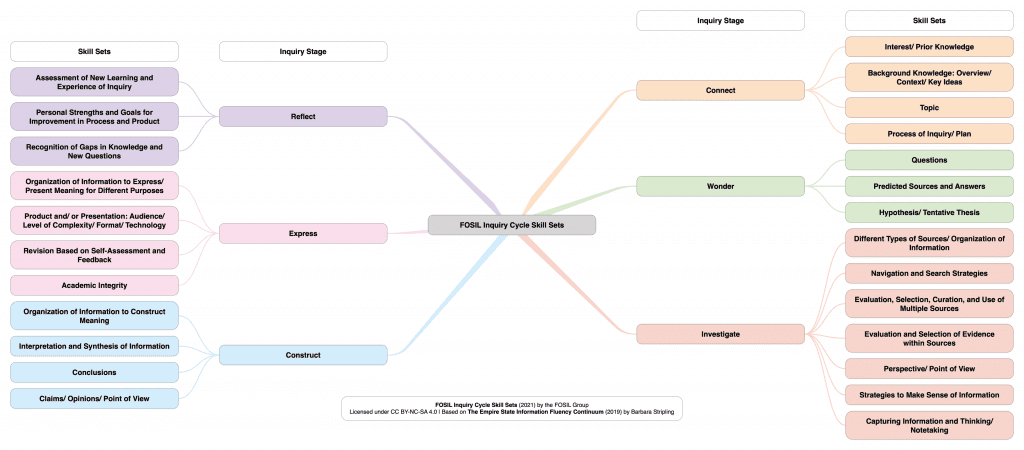
I also chose to look further into The FOSIL Cycle, as a model for inquiry. It has 6 stages: Connect, Wonder, Investigate, Construct, Express, Reflect. One thing that struck me about this model was the double ended arrows between each cycle, assuming that learners would move back and forth between the cycles as they engaged in the inquiry process. This kind of non-linear learning is very  true of what we often see of students in the primary and secondary context. One step forward, two steps back is common as they engage in learning that is challenging and new.

The FOSIL Cycle also describes various skill sets, which could then be identified and built upon if identified as places that need strengthening in the life of a learner. I have included a diagram that explains these below:

FOSIL Inquiry Cycle Skill Sets

Image taken from: FOSIl Inquiry Skill Sets (2021) by the FOSIL Group.

A key challenge I see for teacher librarians in both of these models is time. In order to be successful, students will need the time and space to engage fully in each process. In an already full curriculum and school calendar, alongside challenges of engaging with busy teachers, this type of learning needs to be a priority for school leadership to ensure it gets the time given.

References

Kuhlthau, C.C. Prof. (2018)  Longitudinal Evidence of the Influence of the ISP on Information Workers. Retrieved from: https://web.archive.org/web/20210428065707/http:/wp.comminfo.rutgers.edu/ckuhlthau/information-search-process/

The FOSIL Group (2021) Learning by finding out for yourself. Retrieved from: https://fosil.org.uk/fosil-cycle/

Step 1 of 2
Please sign in first
You are on your way to create a site.