
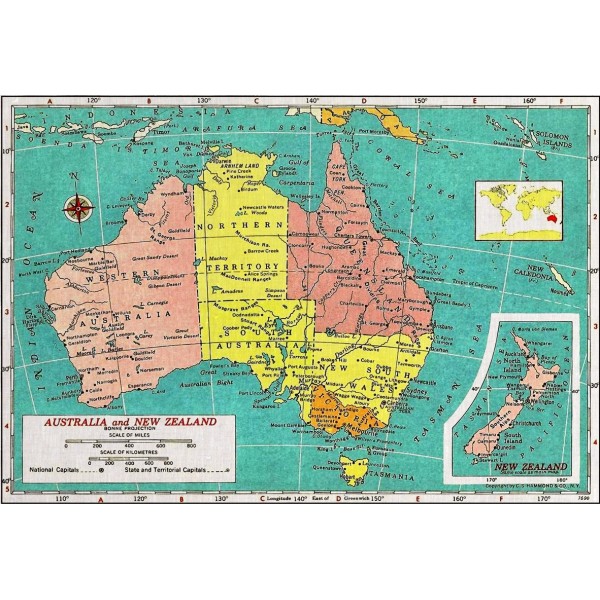
Image source: Davies and Son, vintage Australian map
Transforming My Country (2021) is a project that invited fourteen poets to respond to Dorothea Mackellar’s iconic 1908 poem My Country. In the foreword, editor Toby Fitch describes the initiative as “an attempt to cut through the colonial echo chamber”—a pointed challenge to the persistent narrative of Terra Nullius and the enduring myth of the brave settler who tamed an empty land. The project repositions Mackellar’s romanticised vision of Australia not simply as a poetic celebration of landscape, but as a national myth constructed at the expense of those historically marginalised and silenced. While My Country has often been read as a patriotic ode to the land’s beauty, Transforming My Country asks a deeper question: is this the only—or even the most truthful—way to understand Australia? What other narratives have been left untold?
Laird’s contribution to the project, the digital poem Core Values, exemplifies this challenge. Designed for dviewing in browser or with a VR headset, the poem confronts the idealised landscapes of Mackellar’s original with a darker, more confined vision (Plastier & Laird, 2014) describes Laird’s work as electronic poetry, the form itself is integral—”where a computer is intrinsic to the material properties of the poem.” The viewer is immersed in a digital space that feels boxed-in and claustrophobic, a stark contrast to Mackellar’s “sweeping plains” and “wide brown land.” Laird’s composition consists of brief, declarative statements that reveal a nation hollowed out by bureaucracy and industry: Australia becomes “a melanoma for a sunburnt country,” a place where “Liberty is reserved for Coal, iron ore, gold and meat.”
The poem replaces Mackellar’s emotional and nostalgic imagery with cold, technocratic language— “GIS data,” “annexed by bureaucrats”—foregrounding the extractive logic of settler colonialism. The constantly shifting screen, with text that scrolls or moves across maps, suggests that national identity is fluid, complex, and in constant motion. The viewer is reminded that truth is temporal—only by acknowledging its evolution can a fuller picture of history emerge. The background imagery of maps, layered within a digital box symbolically represents freedom as something denied to many. Words like “little children will be confined,” “ever name a statistic,” and “every cell a crime scene” evoke Australia as a place of suffering—one that does not discriminate by age, imprisoning both children and adults. Laird cleverly likens this deathly prison to different states that can be understood by varying degrees of knowledge – the death of the coral reefs or prison hulks – a nod to the ships that transported people to this prison island so many years ago. The death has evolved and not only are we hurting people, but we are also bleaching the environment in our oceans as well.
The work can be viewed either as a static image with scrolling text (resembling film credits) or as an immersive experience where the viewer looks upward at a constantly moving landscape. This variability invites reflection on both form and meaning but also demands higher-order interpretive skills. Laird’s work can appear abstract, especially in its non-linear structure—raising the question: where does it begin, and where does it end?
As (Moody, Justice & Cabell, 2010) note, digital texts can offer “pizazz” that attracts readers, and Core Values certainly embodies that quality. However, this also raises pedagogical questions: what skills are necessary for readers to engage critically and meaningfully with such texts? (Luke, 2003) argues that modern literacy requires the ability to decode and critique complex, multimodal texts—those that combine symbols, images, and rapidly evolving digital forms. Laird’s work, fortunately, can also be accessed in written form, a helpful scaffold for classroom contexts. As (Beltran et al., 2017) highlights, the benefits of digital texts are best realised when supported by teacher guidance. A print version of the text allows students to engage with more literal vocabulary—such as Laird’s description of “freedom” and “liberty” as commodities like coal, iron, and meat—where inanimate exports are free to leave the country while many living in poverty remain confined.
Laird’s Core Values sits alongside other works that attempt to reframe Australia’s colonial history from perspectives beyond the dominant white settler narrative. By reimagining both form and content, his work contributes to a critical—and necessary—re-examination of national identity. It invites Australians to confront the injustices of the past and present and to listen more deeply to stories that have long been silenced.
References
Fitch, T. (Ed.). (2021) Transforming My Country. Australian Poetry.
Martin-Beltrán, M., Tigert, J. M., Peercy, M. M., & Silverman, R. D. (2017). Using digital texts vs. paper texts to read together: Insights into engagement and mediation of literacy practices among linguistically diverse students. International Journal of Educational Research, 82, 135–146. https://doi.org/10.1016/j.ijer.2017.01.009
Laird, B. (2021). Core Values. Poetry.codetext.net. https://poetry.codetext.net/core-values/
Luke, C. (2003). Pedagogy, Connectivity, Multimodality, and Interdisciplinarity. Reading Research Quarterly, 38(3), 397–403.
Moody, A. K., Justice, L. M., & Cabell, S. Q. (2010). Electronic versus traditional storybooks: Relative influence on preschool children’s engagement and communication. Journal of Early Childhood Literacy, 10(3), 294–313. https://doi.org/10.1177/1468798410372162