
Progress and change is inevitable – this is a fact we can all agree with. As the world has evolved, technology (even in its earliest primitive forms) have changed the way we function – with each other, and the world around us. From the invention of the printing press, cars, the calculator, telephones, the internet and the latest self driving cars, change is occurring constantly.
As a teacher librarian, part of my role is to help prepare students for the digital world in which they are living – to be capable, critical and confident creators. It is in this world that digital literature also exists, and I have some concerns. Even though I applaud the use of clever storytelling using digital tools and love how they help to engage our most reluctant readers, I still think we need to proceed with care and thought.
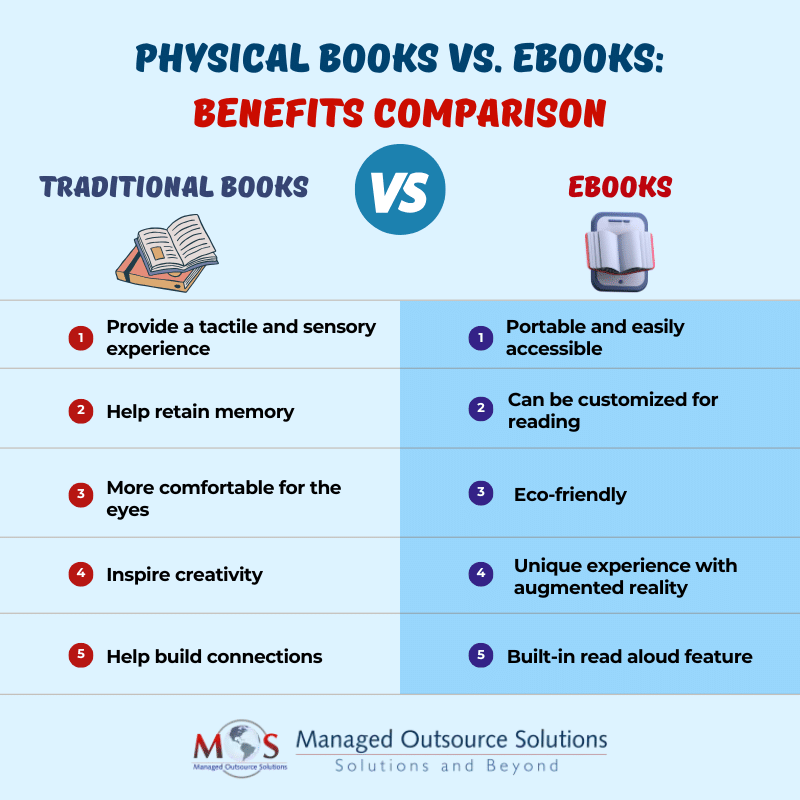
https://www.managedoutsource.com/blog/benefits-reading-traditional-books-ebooks/
Infographics, like the one above from (Managed Outsourced Solutions, 2024) are everywhere online. They are neatly packaged to produce quick points to promote both avenues of reading, but there are much deeper issues underneath these points that deserve careful thought.
It is true, there are advantages to both forms of reading. (Sadokierski, 2013) states that enhanced electronic books are changing our definition and expectation of books. With this change of expectation and definition must also be a raft of considerations:
- Does the still existent digital divide make digital narratives inaccessible for some?
- Do all students have access to the education they will require to learn how to interact with and read digital narratives?
- What defines a digital narrative of quality? How do we ensure our students have access to these quality narratives?
- How do we balance traditional literacy with the need for teaching new literacies in an already full curriculum?
Considerations also need to be thought about how we ensure that traditional literacies and formats remain prevalent, while knowing when to use the new (Wolf, n.d.). It can be confusing though, as research can often be contradictory, as discussed by (Jabr, 2013). Some studies reveal that reading on paper reveals better test scores when engaging with comprehension questions, while some shows so little difference it is not an issue, even with long term memory.
Like any new technology, time will ultimately tell. But I feel a responsibility to move cautiously and with care, to ensure that all types of literacy are offered to my students.