Proactive Approaches to Leading Change

Not many teachers would disagree with the desire of the teacher librarian to want to integrate digital technologies in a way that is meaningful and adds to a child’s education. One of the biggest barriers I face when encouraging the use of technology and digital literacy is time. Time to learn how to use and teach the use of new technologies, and time to integrate them into an already busy and full curriculum.

As a TL, I aim to model servant leadership in my school. I want to be efficient and make a difference to student learning outcomes in whatever way I can. (Robinson, 2007) notes that leaders who are as close to the core business of teaching and learning are more likely to make a difference to student learning outcomes. (Greenleaf, 1970, p. 15) notes that the idea of a servant as a leader takes on a new perspective than other forms of leadership – it focuses on the needs of the followers and ensures that those needs are served. My first step would be to look at what the primary needs are in order to implement information and digital technologies in my school. What do the teachers need in order to integrate this into their curriculum? What resources does the library need to support them to do this?

Additionally, if we are to function most effectively in the model of servant leadership, we need to be aware of how this plays out practically in the areas we want to influence, such as the work of (Spears, 2010) in the ten characteristics of Greenleaf’s servant leadership model. I would focus on the following three aspects of these characteristics to model servant leadership in my approach with teachers:

  • Listening and empathy: Making the time to listen and empathise with busy teachers who need help if they are to integrate new technologies. I try to make time to have a cuppa and chat with the teachers in my school – what pressures are they facing? How can I help? This approach will go a long way toward building relationships as well.
  • Foresight: I would like to aim to have the foresight to attend curriculum planning meeting and set achievable goals for integrating more technology. Perhaps starting with a year group, or subject and working with teachers on achieving one small goal. This may just be the motivation and success needed to build momentum for further technology integration.
  • Commitment to growth: As a servant leader, I need to be not only committed to helping teachers grow in their technology skills, but I also need to be committed to growth – how can I upskill in how I teach digital technologies to teachers and students?

References

Greenleaf, R. (1970). The servant as leader. Indianapolis, IN: Robert K. Greenleaf Center.

Robinson, V. 2007. School Leadership and Student Outcomes: Identifying What Works and Why. Winmalee, NSW: Australian Council of Leaders.

Spears, L. C. (2010). Character and servant leadership: Ten characteristics of effective, caring leaders. The Journal of Virtues & Leadership, 1, 25–30.

 

Digital Story Telling Project Proposal

My digital story will serve two main purposes: to share the historical narrative of a significant figure in Australian history and to act as a model for students, who will use a digital platform to create their own stories. This project will be part of our library unit, which integrates digital competencies through the framework of the history curriculum, particularly focusing on the stories of early settlers and Indigenous people during the colonial period.

(Smelda et al., 2014, pg. 2) discusses that digital storytelling is recognised as an effective pedagogical approach that enhances student motivation and supports story creation through benefits like collaboration and reflection. I will use Book Creator to create a story which will centre on the life and accomplishments of Mary Reiby, a prominent historical figure studied in the Year 5 History syllabus. It will incorporate key features of historical fiction—such as plot, authentic historical settings, dialogue, and characters—by transforming key events from Mary’s life into a narrative format students will be guided to identify as historical fiction. Book Creator offers different book formats, such as comics and a variety of layouts, alongside the option to upload your own images and record audio. It is an intuitive platform to use, and its customisable options means that I can ensure that the main elements of the story are the focus, rather than unnecessary digital add ons that take away from the readability of the text.

After reading the story, students will be asked to identify major challenges, achievements, and events in Mary’s life, designed to gauge their understanding and comprehension of the text. They will also be prompted to reflect on and discuss the digital skills required to create a similar story.

References

Smeda, N., Dakich, E., & Sharda, N. (2014). The effectiveness of digital storytelling in the classrooms: a comprehensive study. Smart Learning Environments, 1(1). https://doi.org/10.1186/s40561-014-0006-3


Digital Literature Review – The Boat

The Boat, an interactive graphic novel adapted from the original short story by Nam Le, conveys the story of a young refugee fleeing Vietnam by boat. Created in collaboration with SBS and artist Matt Huynh, the adaptation immerses readers in Mai’s experience as she travels by boat to Australia in horrific conditions. The narrative reflects the real stories of many Vietnamese people who fled their homeland following the fall of Saigon.

While traditional texts depend on the printed word to evoke emotion, movement, and setting, The Boat demonstrates the powerful potential of digital storytelling to deepen reader engagement through its multimodal elements. Even though imagination plays a critical role in literary instruction (McGinley et al., 2017) this digital adaptation uses visual art, animation, sound design, and interactive features to enhance and intensify emotional resonance. Readers are drawn into the story through sensory cues and motion — for instance, the shifting screen mimics the rocking of the boat, and layered sound effects heighten tension and provoke emotional response. The colour palette employed – monochrome and its various shades, darkened or lightened in different parts of the story are bought into reality by interspersed photos of real Vietnamese families – putting faces to the suffering.

This interactive format also allows readers to move through the story at their own pace, lingering on text or design elements as needed. Such pacing encourages thoughtful reflection and invites readers to consider how visual and auditory techniques contribute to the starkness and gravity of Mai’s journey. In doing so, The Boat places readers directly in the protagonist’s position, fostering empathy and a more immersive experience. The benefits of the multimodal aspect of this piece are beneficial in highlighting an experience that is often hard to imagine unless lived – promoting empathetic responses that may be beneficial for understanding the human impact of displacement. For issues that are critically important in a student’s understanding of the world, by experiencing Mai’s journey in a sensory, embodied way, readers are invited not just to observe, but to feel the stakes of her story.

Although this format is highly engaging and offers substantial educational value, it is not without its limitations. Practical barriers — including inconsistent internet access, limited bandwidth, and lack of suitable devices — can restrict student participation, particularly in under-resourced settings. Additionally, the layering of visual, audio, and textual elements may overwhelm some learners, especially those with sensory sensitivities or diverse learning needs. However, these limitations do not preclude the use of The Boat as an effective teaching resource. With thoughtful scaffolding and differentiated support, educators can adapt the experience to promote accessibility and inclusion for all students.

As (Australian Institute for Teaching and School Leadership Limited [AITSL], 2024) cautions, despite the increasing availability of digital tools, Australian students’ digital literacy skills have declined over time. This highlights the importance of ensuring that digital texts like The Boat are introduced in a pedagogically sound manner that builds student capability. (Dalton & Rose, 2008, p. 349) advocate for a digital reading heuristic that scaffolds engagement with digital literature by guiding students through structured phases — including an introduction to the digital format, targeted learning activities, and framing within a relevant sociocultural context. Moreover, features within The Boat, such as the option to control sound and navigate at an individual pace, offer flexibility that can support a range of learner needs. Together, these strategies enable teachers to make meaningful use of the text while ensuring equitable access and understanding. This type of strategy places The Boat as part of a learning experience, set within a range of activities to build student’s knowledge and understanding, not the only experience. In addition to its adaptability, this type of interactive graphic novel may be appealing to those who are decidedly ‘non-readers.’ (Fuller, 2014) discusses the combination of graphic novels and digital technology as a combination that draw the most reluctant reader into the story. In the days of instant gratification and quick scrolling, teachers have to be constantly adapting and offering activities and texts that will engage students and help them to develop not only their comprehension, but perhaps even a like for reading – regardless of whether that text is digital or in print. After all, they are reading, aren’t they?

References

Australian Institute for Teaching and School Leadership Limited (2024). Spotlight – Evaluating the Evidence for Educational Technology. https://www.aitsl.edu.au/research/spotlights/evaluating-the-evidence-for-educational-technology-part-2-enabling-learning#:~:text=The%20use%20of%20culturally%20relevant,and%20in%20culturally%20responsive%20ways.

Dalton, B. & Rose, D. (2008). Scaffolding Digital Comprehension. In C. C. Block & S.R. Paris (Eds.), Comprehension Instruction, Research-Based Best Practices (2nd ed., pp. 347-361). The Guilford Press.

Fuller, L. (2014, August 13). Graphic Novels for the Digital Classroom. International Literacy Association. https://www.literacyworldwide.org/blog/literacy-now/2014/08/13/graphic-novels-for-the-digital-classroom

Le, N. (2019). The Boat | SBS. SBS. https://www.sbs.com.au/theboat/

McGinley, W., Kamberelis, G., Welker, A., Kelly, M.R., & Swafford, J. (2017). Roles of Affect and Imagination in Reading and Responding to Literature; Perspectives and Possibilities for English Classrooms. Journal of Curriculum Theorizing, Vol. 32, (1), 67-85. https://doi.org/10.63997/jct.v32i1.638

Digital Literature Review – New York Public Library Insta Novels

Review #2 – New York Public Library Insta Novels

Classic literature can often feel daunting or out of reach for many readers. The unfamiliar language and historical context may lead some to overlook these significant works in favour of more contemporary authors. Yet, these stories have shaped the foundations of literature as we know it today—and continue to offer themes, ideas, and insights that remain deeply relevant for modern readers. It was these long-past authors who challenged the boundaries of their time, often subverting gender roles and social expectations to create works that resonated deeply with their audiences. Their courage and innovation paved the way for the literature we enjoy today—where freedom of expression thrives, and voices can be heard beyond society’s attempts to define who we should be.Insta Novels

Image source: https://www.nypl.org/blog/2019/08/20/nypl-insta-novels?utm_campaign=instanovels

Even though classic literature is readily accessible and free through platforms like Project Gutenberg, a new project has sought to bring these classic stories, such as The Yellow Wallpaper, Alice in Wonderland, A Christmas Carol, The Metamorphosis, and The Raven to modern audiences through the publication of these stories on the social media platform of Instagram. A collaboration between The New York Public Library and advertising and creative agency, Mother in New York, has reimagined these classic stories in a format for modern readers. (Lobash, 2019) states the aim of the project is to ‘make great stories available even more widely’. Readers are given instructions to navigate to the stories highlights of the New York Public Library Instagram page to select which story to read. Instructions are given on how to turn the ‘pages’ forward and back, as well as how to hold the page in place while reading. While Instagram is a widely used and intuitive platform, providing simple instructions offers helpful guidance for those less familiar with its features. This initiative pushes back against a lingering nostalgia for print and the persistent idea that digital reading somehow dilutes literary engagement. Instead, it embraces the affordances of digital platforms to reach audiences who might otherwise never interact with canonical texts. Readers can hold down the screen to pause on a paragraph or let the story unfold at its own pace, offering a rhythm that mimics scrolling—a gesture more natural to many young users than flipping a page. By meeting readers where they are—on social media—it reclaims literature as accessible and democratic. In doing so, it opens up new avenues for engagement and interpretation. We might liken it to the revolution of the Gutenberg printing press, which opened up access of information to many that were denied beforehand. How might using technology open up opportunities for access to those who might never pick up a book or enter a library?

There is also an implicit challenge here to notions of literary authority and ownership. The texts in the Insta Novels series are public domain works, but their visual reinvention—through motion graphics, bold typography, and expressive illustration—makes them feel fresh, urgent, and alive. The graphics used in The Yellow Wallpaper Insta novel mimic the theme in the text, of the woman trying to break free, however a certain amount of visual literacy skills is needed to be able to effectively analyse and read this type of communication. That said, the project does raise important questions about literacy and comprehension in digital spaces.

With the explosive growth in the use of social media in technology, a new set of vernaculars has also arrived. Phrases such as ‘zombie scrolling,’ and ‘doom scrolling’ have been used to describe the emotion and motion of our endless interaction on social media. (The Newport Institute, 2024) describes an estimated average that in a single day, phone users scroll through 300 feet of content. If this is the case, what will make these Insta Novels stand out? Will readers take in what they read? (Dyson & Haselgrove, 2000) explored research from the University of Reading that observed that reading comprehension declined when students scrolled, which is in contrast to the focus when reading stationary chunks of text. However, is scroll reading better than no reading? Will even the smallest engagement with the text by a reader help keep the stories alive for a new generation? Rather than ask whether digital platforms “cheapen” literature, it asks: what new possibilities emerge when we reimagine the book not as an object, but as an experience?

References

Dyson, M.C. & Haselgrove, M. (2000). The effects of reading speed and reading patterns on the understanding of text read from screen. Journal of Research in Reading, 23 (2), 210-223.

Lobash, L. A. (2019, August 22). Read NYPL Insta Novels. The New York Public Library. https://www.nypl.org/blog/2019/08/20/nypl-insta-novels?utm_campaign=instanovels

Newport Institute (2024, October 10). 8 Danger Signs of Zombie Scrolling and How to Protect Yourself. https://www.newportinstitute.com/resources/mental-health/zombie_scrolling/

Digital Literature Review – Core Values


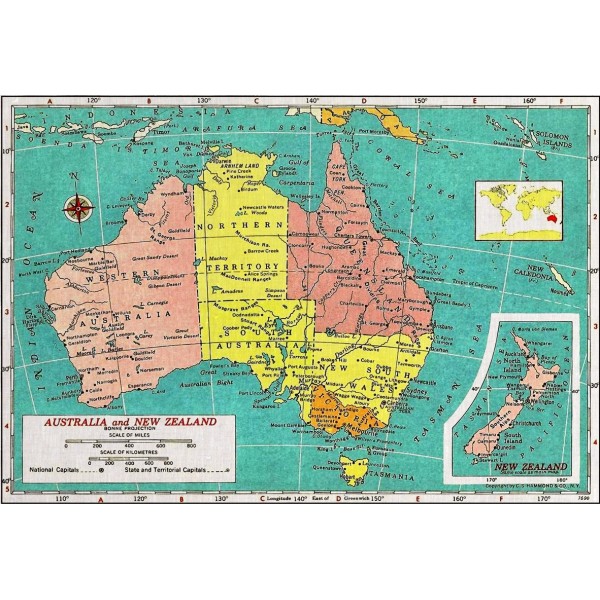
Print | Australian Map - Davies & Son

Image source: Davies and Son, vintage Australian map

Transforming My Country (2021) is a project that invited fourteen poets to respond to Dorothea Mackellar’s iconic 1908 poem My Country. In the foreword, editor Toby Fitch describes the initiative as “an attempt to cut through the colonial echo chamber”—a pointed challenge to the persistent narrative of Terra Nullius and the enduring myth of the brave settler who tamed an empty land. The project repositions Mackellar’s romanticised vision of Australia not simply as a poetic celebration of landscape, but as a national myth constructed at the expense of those historically marginalised and silenced. While My Country has often been read as a patriotic ode to the land’s beauty, Transforming My Country asks a deeper question: is this the only—or even the most truthful—way to understand Australia? What other narratives have been left untold?

Laird’s contribution to the project, the digital poem Core Values, exemplifies this challenge. Designed for dviewing in browser or with a VR headset, the poem confronts the idealised landscapes of Mackellar’s original with a darker, more confined vision (Plastier & Laird, 2014) describes Laird’s work as electronic poetry, the form itself is integral—”where a computer is intrinsic to the material properties of the poem.” The viewer is immersed in a digital space that feels boxed-in and claustrophobic, a stark contrast to Mackellar’s “sweeping plains” and “wide brown land.” Laird’s composition consists of brief, declarative statements that reveal a nation hollowed out by bureaucracy and industry: Australia becomes “a melanoma for a sunburnt country,” a place where “Liberty is reserved for Coal, iron ore, gold and meat.”

The poem replaces Mackellar’s emotional and nostalgic imagery with cold, technocratic language— “GIS data,” “annexed by bureaucrats”—foregrounding the extractive logic of settler colonialism. The constantly shifting screen, with text that scrolls or moves across maps, suggests that national identity is fluid, complex, and in constant motion. The viewer is reminded that truth is temporal—only by acknowledging its evolution can a fuller picture of history emerge. The background imagery of maps, layered within a digital box symbolically represents freedom as something denied to many. Words like “little children will be confined,” “ever name a statistic,” and “every cell a crime scene” evoke Australia as a place of suffering—one that does not discriminate by age, imprisoning both children and adults. Laird cleverly likens this deathly prison to different states that can be understood by varying degrees of knowledge – the death of the coral reefs or prison hulks – a nod to the ships that transported people to this prison island so many years ago. The death has evolved and not only are we hurting people, but we are also bleaching the environment in our oceans as well.

The work can be viewed either as a static image with scrolling text (resembling film credits) or as an immersive experience where the viewer looks upward at a constantly moving landscape. This variability invites reflection on both form and meaning but also demands higher-order interpretive skills. Laird’s work can appear abstract, especially in its non-linear structure—raising the question: where does it begin, and where does it end?

As (Moody, Justice & Cabell, 2010) note, digital texts can offer “pizazz” that attracts readers, and Core Values certainly embodies that quality. However, this also raises pedagogical questions: what skills are necessary for readers to engage critically and meaningfully with such texts? (Luke, 2003) argues that modern literacy requires the ability to decode and critique complex, multimodal texts—those that combine symbols, images, and rapidly evolving digital forms. Laird’s work, fortunately, can also be accessed in written form, a helpful scaffold for classroom contexts. As (Beltran et al., 2017) highlights, the benefits of digital texts are best realised when supported by teacher guidance. A print version of the text allows students to engage with more literal vocabulary—such as Laird’s description of “freedom” and “liberty” as commodities like coal, iron, and meat—where inanimate exports are free to leave the country while many living in poverty remain confined.

Laird’s Core Values sits alongside other works that attempt to reframe Australia’s colonial history from perspectives beyond the dominant white settler narrative. By reimagining both form and content, his work contributes to a critical—and necessary—re-examination of national identity. It invites Australians to confront the injustices of the past and present and to listen more deeply to stories that have long been silenced.

References

Fitch, T. (Ed.). (2021) Transforming My Country. Australian Poetry.

Martin-Beltrán, M., Tigert, J. M., Peercy, M. M., & Silverman, R. D. (2017). Using digital texts vs. paper texts to read together: Insights into engagement and mediation of literacy practices among linguistically diverse students. International Journal of Educational Research, 82, 135–146. https://doi.org/10.1016/j.ijer.2017.01.009

Laird, B. (2021). Core Values. Poetry.codetext.net. https://poetry.codetext.net/core-values/

Luke, C. (2003). Pedagogy, Connectivity, Multimodality, and Interdisciplinarity. Reading Research Quarterly, 38(3), 397–403.

Moody, A. K., Justice, L. M., & Cabell, S. Q. (2010). Electronic versus traditional storybooks: Relative influence on preschool children’s engagement and communication. Journal of Early Childhood Literacy, 10(3), 294–313. https://doi.org/10.1177/1468798410372162


Explicit or Inquiry?

It often seems to be that in education and its many pedagogies and approaches, it is sometimes a war between explicit teaching and inquiry based learning.

(Reid, n.d.) sums it up by stating: For some time now the education debate in Australia has been marred by the presence of a simple binary: explicit teaching or direct instruction versus inquiry-based teaching.

Inquiry based teaching has been blamed for the low literacy and numeracy results on standardised testing, and explicit instruction apparently leaves our students with no imagination or ability to create. I see the library as a place where these two approaches can meet in perfect harmony – in the use of digital technologies.

Any future looking educational agenda needs to position students not as passive consumers of a pre-defined set of ‘curriculum truths’ but as legitimate participants in various knowledge communities and, potentially, as producers of new knowledge.

(Rowan, 2012, p. 219)

Rowan’s assertion that education must move beyond positioning students as “passive consumers of a pre-defined set of ‘curriculum truths’” (2012, p. 219) challenges the foundational dynamics of traditional classroom practice. It is a call to reimagine students not as vessels to be filled with static knowledge, but as engaged participants in the co-construction of understanding, inquiry, and meaning. As an educator, this quote resonates deeply with both my philosophy and my evolving approach to teaching and learning.

This quote from Rowan defines students as participants and producers. Before students can be these things however, they need to have a solid foundation of technology – how to create ethically and with integrity, and how to use the different technologies available. This is where explicit teaching comes in – there is a time and place for TL’s to explicitly instruct students in how to physically use different apps and programs, and the implications that comes with being a creator. Once this explicit teaching has been done, students can then be tasked with being creators and participants in this technology – creating stories, programs, apps, and uses of technology that make their world a better place, express their ideas and personality, and experiment with this ever changing technology (ultimately helping them prepare for the world they will live in).

This approach comes with its challenges, such as:

  • Rethinking assessments: Traditional assessments often reinforce the idea of fixed knowledge, whereas authentic assessment—portfolios, presentations, creative products—can better capture the process of knowledge-making. It also highlights the importance of feedback loops, where dialogue between teacher and student fosters reflection, revision, and growth.
  • Time constraints
  • Teacher confidence and knowledge in new technologies
  • Systemic expectations of teaching and its outcomes

Ultimately, Rowan’s quote reminds me that education should not be about the transmission of static truths but about engaging with the dynamic, evolving nature of knowledge itself. When we position students as legitimate participants and creators, we don’t lose control—we gain relevance, energy, and purpose. And perhaps most importantly, we offer students the chance to see themselves as thinkers, agents, and contributors in a world that urgently needs their ideas.

Leadership and Student Outcomes

In the daily rush of school life, it’s easy to to get caught up in the noise. Emails, compliance tasks, student concerns, staff shortages—each can feel urgent and essential. But at the core of school leadership lies a responsibility too important to be overshadowed: improving student learning outcomes. I find that too often, this can be pushed aside, even with tasks that are important – such as student mental health, event organisation, parent emails and meetings – the list never ends.

I was challenged by the research done by (Smith, 2016) in the article: The Role of Leadership Style in Creating a Great School. Smith focused on the different leadership types of school administrators, but his discussion around the focus on student outcomes especially challenged me:

Most importantly school vision must be directly related to student learning and the pursuit of finding ways to improve learning in the school. “Achieving the vision requires their work to be deeply informed by knowledge of how to improve learning and teaching. Tat is why we must put education back into educational leadership” (Robinson, 2011, p. 155).

As a teacher librarian, this is one of the ways that I can be a visible leader – focusing on assisting and resourcing teachers to improve their practice, and therefore, improving outcomes for students. Finding resources to support curriculum outcomes, providing training (especially in technology and information resources) and being someone teachers can go to for support and motivation. I often find teachers appreciate a chat and ‘space to vent’ when they are in the library doing their photocopying, or picking up books, and this has been an informal way I have found to offer support and leadership.

The following quote sums it up:

Doing the Real Work that Matters - Read Write Respond

Image source: https://readwriterespond.com/2019/07/real-work/

References:

Davis, A. (2019, July 11). Doing the real work that matters. Read, Write, Respond. https://readwriterespond.com/2019/07/real-work/

Smith, B. S., (2016), The Role of Leadership Style in Creating a Great School,  SELU Research Review Journal, 1(1), 65-78.

Thoughts on modern theories

Watching (Robinson’s, 2010) video on changing education paradigms  (watch https://www.youtube.com/watch?v=zDZFcDGpL4U) was a challenge and made me think about how theories and the lens in which we view education and our approach to organisational structures and leadership.

(Kilicoglu & Kilicoglu, 2019) discuss the concept of metamodernism, formed by cultural theorists (Vermulen & van den Akker, 2010) to focus on educational issues and culture. The focus of the study by (Kilicoglu & Kilicoglu, 2019) was on Nordic countries, who lead the way in high educational outcomes for students. I found some of the leadership values and notions mentioned by this article interesting, considering the hierarchical structure our schools were formed by, hundreds of years ago.

  • Nordic countries often have minimum authority/power distance between leaders and workers
  • They have a high degree of gender equality
  • People are encouraged to pursue their individual dreams
  • They are high and early adopters of digital technologies and form strong bases of infrastructure for these new technologies.

Metamodernism seeks to situate itself between postmodernism and modernism – oscillating between both. If metamodernism can be described as ‘beyond’, ‘with’ and ‘between’, – being constructive (Lathan, 2015) and taking the best of what was in the past and adapting it for a new culture and time, then it makes sense that the changes in educational approaches and teaching are formed through the new pedagogies of digital technologies (Siljander, 2017).

The article further discusses approaches used in Nordic countries that embrace adaptive learning technologies, mixed reality and a focus on students being able to work both individually and with groups. These approaches seem to take the best of what has been done in the past and are aligning them with a modern culture that seems to me would be engaging for students.

In terms of its leadership model, (Mortimore, 2013) describes Nordic countries delegate and share leadership, rather than ‘heroic’ leadership. Futhermore, (Moos et al., 2013) describes school leadership in these countries as being based on collaborative decision making, with a focus on distributed leadership and team work.

This article and discussion did give me a boost as I often get disheartened by the apathy and lack of engagement in students that I see in my school, and by discussions with teachers in Australia. This serves to remind me why leadership and leading pedagogy is so important and critical in our schools – it provides the foundation and launchpad for everything else to follow.

More thinking is required on my part as I grapple with these issues and think forward in my own career as to what kind of educator and leader I want to be.

References

Kilicoglu, G., Kilicoglu, D. The Birth of a New Paradigm: Rethinking Education and School Leadership with a Metamodern ‘Lens’. Stud Philos Educ 39, 493–514 (2020). https://doi.org/10.1007/s11217-019-09690-z

Lathan, M. 2015. A poetics of postmodernism and neomodernism: Rewriting Mrs Dalloway. London: Palgrave Macmillan.

Moos, L., K.K. Kofod, K. Hjort, and P.H. Raae. 2013c. Denmark: New links between education. In Transnational influences on values and practices in Nordic educational leadership: Is there a Nordic Model? (Chp 2), ed. L. Moos, 19–30. Dordrecht: Springer.

Mortimore, P. 2013. Peter Mortimore: Nordic leadership: Something worth keeping. In L. Moos (Ed.), Transnational influences on values and practices in Nordic educational leadership: Is there a Nordic Model? (Forewords, pp. vi–viii). Dordrecht: Springer.

Robinson, K. [RSA Animate]. (2010, October 14). Changing education paradigms [Video]. YouTube. https://www.youtube.com/watch?v=zDZFcDGpL4U

Siljander, P. 2017. School in transition: The case of Finland. In Schools in transition: Linking past, present, and future in educational practice, ed. P. Siljander, K. Kontio, and E. Pikkarainen, 191–212. Rotterdam: Sense Publishers.

van den Akker, R., A. Gibbons, and T. Vermeulen. 2017. Metamodernism: Historicity, affect, and depth after postmodernism. London, New York: Rowman & Littlefield International.


Are all books created equal?

Progress and change is inevitable – this is a fact we can all agree with. As the world has evolved, technology (even in its earliest primitive forms) have changed the way we function – with each other, and the world around us. From the invention of the printing press, cars, the calculator, telephones, the internet and the latest self driving cars, change is occurring constantly.

As a teacher librarian, part of my role is to help prepare students for the digital world in which they are living – to be capable, critical and confident creators. It is in this world that digital literature also exists, and I have some concerns. Even though I applaud the use of clever storytelling using digital tools and love how they help to engage our most reluctant readers, I still think we need to proceed with care and thought.

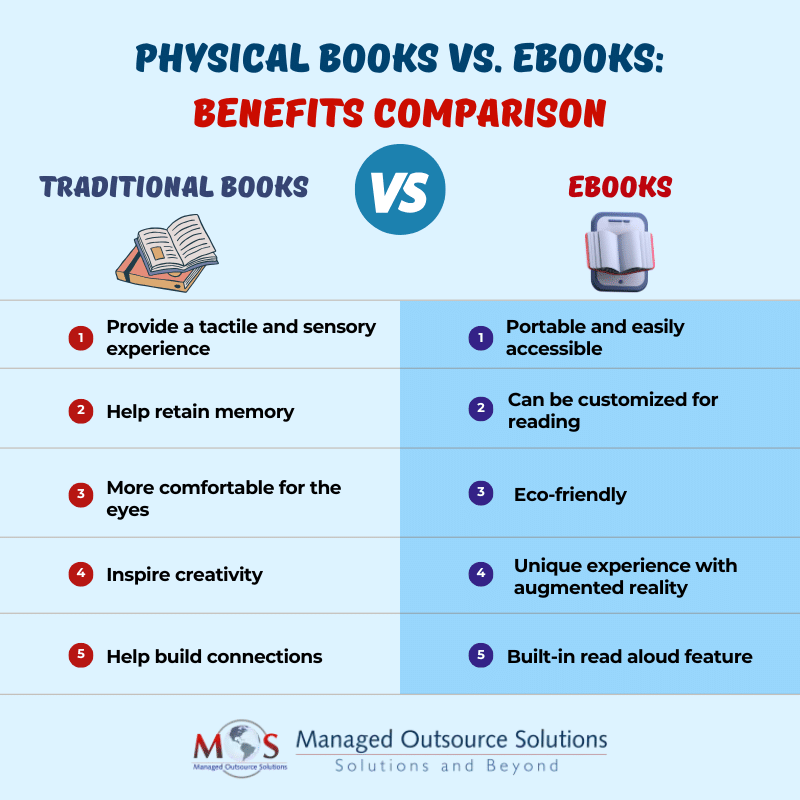
Physical Books vs. eBooks: Benefits Comparison

https://www.managedoutsource.com/blog/benefits-reading-traditional-books-ebooks/

Infographics, like the one above from (Managed Outsourced Solutions, 2024) are everywhere online. They are neatly packaged to produce quick points to promote both avenues of reading, but there are much deeper issues underneath these points that deserve careful thought.

It is true, there are advantages to both forms of reading. (Sadokierski, 2013) states that enhanced electronic books are changing our definition and expectation of books. With this change of expectation and definition must also be a raft of considerations:

  • Does the still existent digital divide make digital narratives inaccessible for some?
  • Do all students have access to the education they will require to learn how to interact with and read digital narratives?
  • What defines a digital narrative of quality? How do we ensure our students have access to these quality narratives?
  • How do we balance traditional literacy with the need for teaching new literacies in an already full curriculum?

Considerations also need to be thought about how we ensure that traditional literacies and formats remain prevalent, while knowing when to use the new  (Wolf, n.d.). It can be confusing though, as research can often be contradictory, as discussed by (Jabr, 2013). Some studies reveal that reading on paper reveals better test scores when engaging with comprehension questions, while some shows so little difference it is not an issue, even with long term memory.

Like any new technology, time will ultimately tell. But I feel a responsibility to move cautiously and with care, to ensure that all types of literacy are offered to my students.


Beginning thoughts on Digital Literature


Task: Using your readings and interaction with the subject to date, develop a statement about your current knowledge and understanding of concepts and practices in digital literature environments, tools and uses, within the context of your work or professional circumstances.

I like to consider myself fairly capable when it comes to digital technology and am committed to using technology in my teaching programs. I feel strongly that students should be taught how to use technology in a thoughtful, critical and reflective way – for purposes that will add to the good being done in the world. It always feels like a contentious issue amongst staff though – many with the view that the less ‘screens’ children have, the better they will be. In one sense, I agree with this. There are not many things that can beat the learning that comes with unstructured, child led play and immersing oneself in a book where imagination is a key ingredient to building images in your mind.

However, it is our responsibility as educators to prepare our students for the world they will encounter and live in – and technology is a big part of that. It would be ignorant to ignore that the landscape of literature has changed and evolved since the emergence of technology. (Harjono & Wiryotinoyo, 2021) describe such benefits of digital literature as strengthening student comprehension, engagement and motivation. (Sandy & Suryaningtyas, 2022) bring balance to these benefits by explaining their research findings that the best outcomes occur when digital learning and traditional learning are negotiated so students have access to equal exposure of both. This resonates with my own views that even though digital literature offers many benefits, it does not negate the needs for traditional learning experiences.

As a teacher, I feel that my skills in creating my own digital stories are lacking and I am looking forward to growing in my skill base in this. One of the challenges I have faced in the past is the time required to build skills in this area; as understanding and learning how to drive technology can be time consuming. However; it is a priority and time needs to be set aside to learn, hence it being one of my key priorities for professional development in the next 6 months.

I am looking forward to engaging with this subject and the learning that will occur.

References: 

Harjono, H. S., & Wiryotinoyo, M. (2021, August 26). Exploring the Benefits of Digital Storytelling for Enhancing Teaching and Learning. Atlantis Press. https://doi.org/10.2991/aer.k.210825.047

Sandy, F., & Suryaningtyas, A. A. (2022). Research Takeaways: The Benefits of Digital Literacy in the Early and Middle. Jurnal Ilmiah Media, Public Relations, Dan Komunikasi (IMPRESI), 3(2), 1–5. https://doi.org/10.20961/impresi.v3i2.71427.g39691

Step 1 of 2
Please sign in first
You are on your way to create a site.